Skip to content
A trailer hauling heavy equipment between two sites
Fleet & assets

No asset moves without a written trace

Every check-out, check-in, and transfer between sites is recorded with who requested it, who approved it, who received it, and when — with condition photos. Asset status and location update from the latest approved movement, not from a separate entry.

Before

What happens today without this module

  • 01Machines move on a phone call, and custody accountability is lost
  • 02The asset’s location in the system doesn’t match where it actually is
  • 03Disputes over who received what, and when, find no document to settle them
Capabilities

Exactly what this module does

  • 4 movement types

    Out to work, in to the yard, transfer between sites, and in to maintenance — each with its own effect on status.

  • Transition guard

    A maintenance movement requires an open fault report on the asset, and a transfer is rejected while the asset sits in the yard — closing the door on workarounds.

  • Approval path

    A movement waits for the authorized approver before it takes effect.

  • Receiver and photos

    A receiving delegate, condition photos, and coordinates attached to the record.

  • Lowbed transfer cost

    Free with no lowbed trailer, optional with an internal one, and mandatory with an external one before approval — enforced by the system, not by custom.

  • Void, not delete

    A voided movement stays in the log marked with who voided it and why — never erased — and status is restored from the last standing movement.

  • History import

    A ready file of 12 Arabic columns with dropdowns matching the form, to load past movements in one batch.

Inside the service

How it actually works in your company

When a machine moves on a phone call, the system loses its real location, custody responsibility evaporates, and the argument over who received it and when has no document to settle it. This service makes every exit, entry, and transfer a recorded movement carrying its requester, approver, receiver, time, and coordinates — and the asset's status and location in the system change only through an approved movement. Where is the machine right now becomes a question the log answers, not a guess, and custody is backed by a document.

01

Four types govern the path

A movement is recorded as one of four types: exit for work or rental, entry to the yard, transfer between sites, or entry to maintenance — each with its defined effect on the asset's status. The system also guards the transition logic itself: a maintenance entry is refused unless the machine has an open fault report, and a site-to-site transfer is refused while the machine is still in the yard, closing the door on fictitious records before they start.

02

Approval is a defined authority

A movement is created pending and affects nothing until approved, and approval is restricted to administration, the movement officer, and the project manager. At the moment of approval the system updates the asset's status and location according to the movement type, sends an internal notification and an email to company management with the movement number, machine, destination, and cost, and broadcasts the event to the client's connected systems through the integration module when it is enabled.

03

The lowbed rule is server-enforced

Transport cost is not a free field but a rule: a movement with no lowbed is free and the system zeroes its cost; with an internal lowbed the cost is optional and recorded if entered; with an external lowbed it is mandatory, and the server refuses to approve the movement until a positive cost is entered. The rule is applied at the approval point itself, not merely in the interface, so no external haul passes without a cost charged to the asset.

04

The latest rules, cancellation never erases

A movement's effect on status is applied only when it is the asset's latest standing movement, so a late approval of an older movement never rolls the state backward, whatever the approval order. Cancellation is a documented administrative correction: it records who cancelled, their role, the reason, and the time; the cancelled movement disappears from all operational reads without being deleted, and the asset's state is automatically restored from the last standing movement.

05

Two doors in, one log

A movement is recorded from the office or from the field by scanning the machine's code on a public page that makes location capture mandatory and picks the delegate from the registered operator roster rather than free typing. Historical movements are imported from a template of twelve Arabic columns whose dropdowns match the form's own options, so years of archive enter in a single session onto the same unified log.


Inside the product

The screen as your team uses it

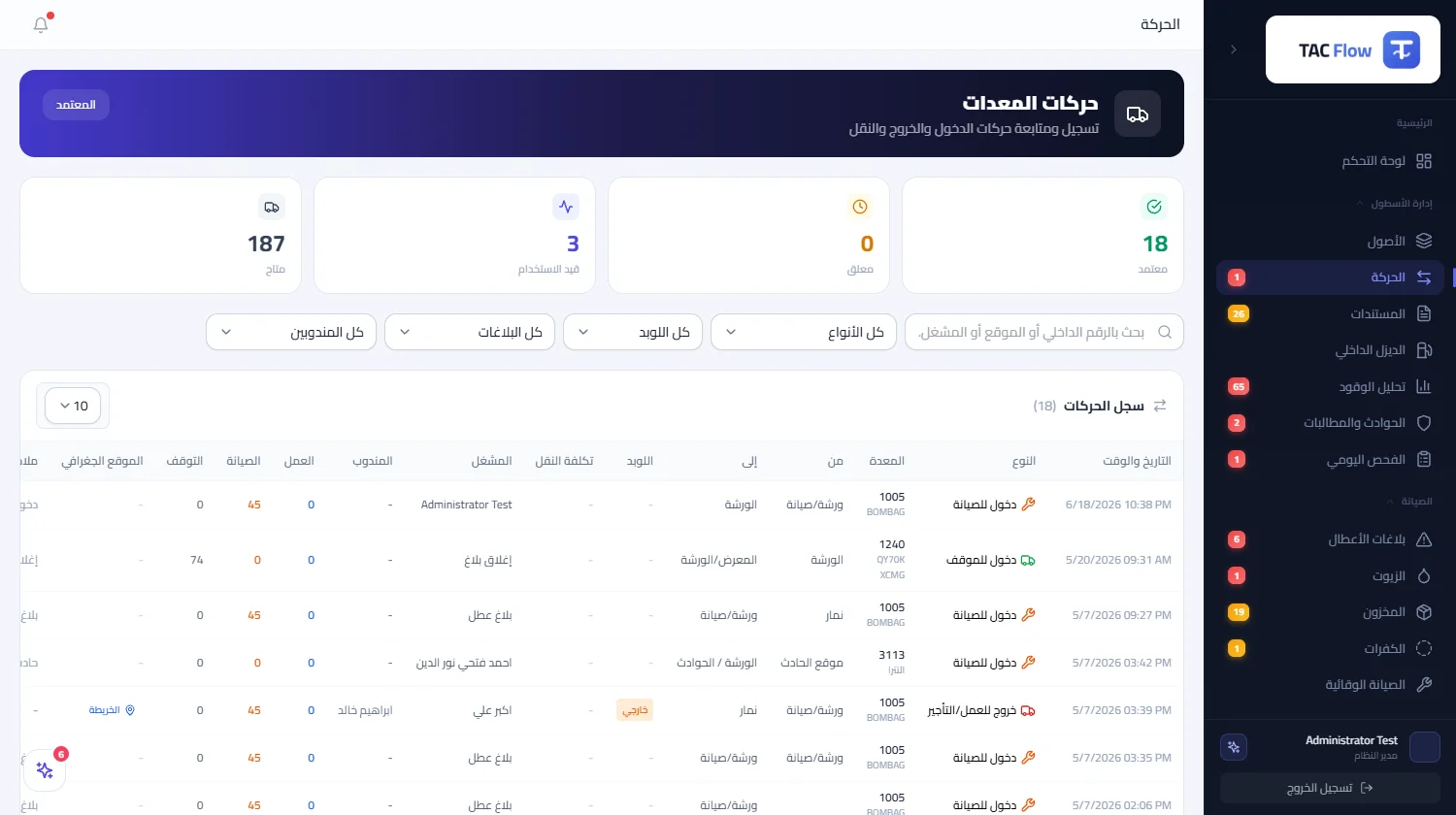
Asset Movements
Screen of Asset Movements
From the field, no account

One code on the asset opens all of this

The technician or driver scans the code printed on the asset and a public page opens in four languages — they submit directly, with no account and no app, and the entry lands on the asset record instantly.

  • A four-language interface, with free text auto-translated
  • A draft that never dies: saved on-device and restored even after a network drop or a closed browser
  • Duplicate-proof submission, with ID numbers shown masked
Try the asset search

What gets recorded from this page for this module

Straight from the work site

  • Check-out to work
  • Check-in to the yard
  • Site-to-site transfer
The flow

How the process runs end to end

  1. 01

    Request

    Record the movement with its type and destination

  2. 02

    Approval

    Sign-off by the authorized approver

  3. 03

    Execution

    A receipt documented with photos and location

  4. 04

    Update

    Asset status and location change accordingly

After rollout

What actually changes

No promises built on numbers we don’t know about your company. What follows is the structural difference of wiring this module into the rest of the platform.

Matching location
between the system and reality
Backed custody
by a document, not a story
Visible transfer cost
charged to the asset and the project

Limits of this module

An older movement never overrides a newer one: the status effect is applied only from the latest approved movement — by design, to stop status from rolling backwards.

Try Asset Movements on your own assets — not a generic example

We tailor the demo to your operation, starting with the module that blocks your team today.