Inside the service
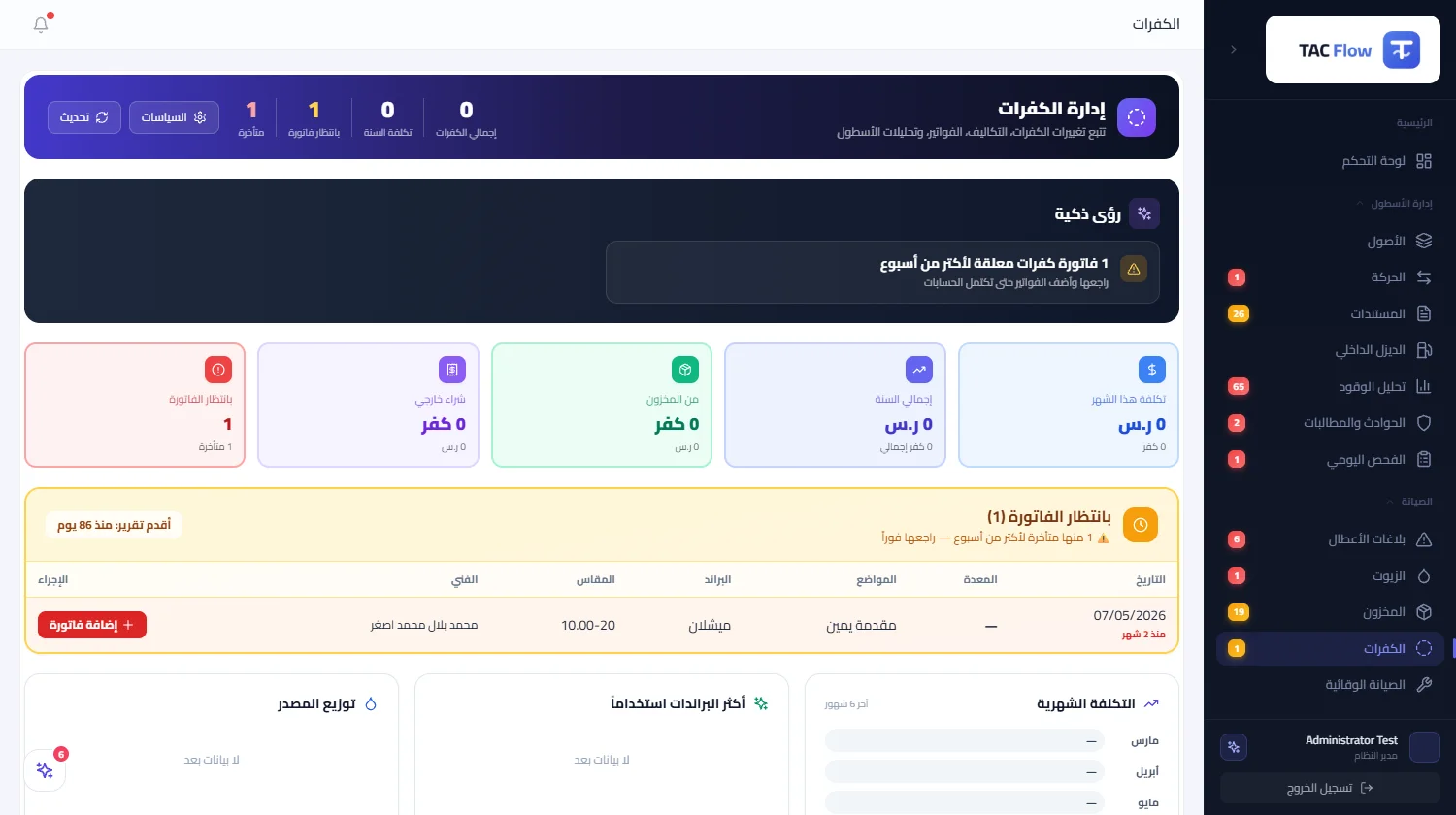
Tires are a major spend that usually dissolves into general maintenance cost: replacements happen without a policy, positions are forgotten, and the invoice arrives as a number with no record behind it. This module treats the tire as a small asset with a position, a cost and a policy: every change is logged by its positions on the vehicle and the meter reading at the moment of change; the source is either stock — deducted through a real inventory movement — or an external purchase whose file only closes with its invoice; and replacement policies are set at three scopes.
01
Change by position and reading
No change is accepted without at least one position marked on the vehicle, and the tire count derives from the positions themselves rather than a typed number. Recorded with the change are the meter reading in kilometers or hours, the brand, size and production number of the tire, photos, and the executing technician — so every position gains a readable history: when it was changed, at what reading, and with which tire.
02
Stock deducted, or invoice pending
A change sourced from stock deducts the tires from the item's balance through a real inventory movement before the change itself is recorded — if the deduction fails, nothing is recorded, and no change is ever booked against stock that does not exist. An external purchase opens a file awaiting its invoice, and it only closes once the invoice is attached with its number and image — so the list of what still awaits an invoice stays visible to management until it clears.
03
Policies at three scopes
The replacement policy can be set for a whole asset class, for a specific equipment type, or for a single vehicle with its own circumstances — with thresholds in kilometers, hours or months, plus the axle count, tires per axle, and the default brand and size. The decision rule becomes uniform across the fleet instead of varying between workshops, while a legitimate exception stays contained to its scope rather than leaking to everyone.
04
Visible cost, fleet indicators
Every change carries its unit and total cost and lands on the asset, so tires appear as an independent, comparable line: the cost trend month by month, the units consuming the most, the brand distribution, and stock issues versus external purchases. The vehicle's tire kit — running and spare counts — is set from the public field page in four languages, and a tire change can also arrive inside a field maintenance report whose approval creates the record and the stock deduction together.