Skip to content
Scheduled maintenance on a machine inside a workshop
Maintenance & safety

Maintenance happens on schedule, not in the middle of the site

Maintenance plans scheduled on engine hours, kilometers, or calendar dates for assets without a meter, with alerts before due — moving operations from reaction to anticipation.

Before

What happens today without this module

  • 01The due date lives in someone’s memory, so it slips
  • 02Downtime hits mid-project, at the highest possible cost
  • 03No unified standard for maintenance intervals across machines
Capabilities

Exactly what this module does

  • No default interval — honestly

    The system never assumes an interval; a unit with incomplete data shows “Needs setup” rather than being scheduled on a fiction.

  • 4 tasks per machine

    Engine oil, air filter, fuel filter, and hydraulic oil — each item with its own interval and rule.

  • Multiple triggers, earliest wins

    Engine oil is watched by hours, working days, and months — and even long idling forces a change upon return.

  • A broken-meter branch

    A machine with a broken meter is scheduled by time explicitly — it neither drops out of tracking nor gets scheduled on a dead reading.

  • A jump guard

    A reading that jumps implausibly requires explicit confirmation and is flagged for the reviewer, and going backwards is rejected.

  • An honest initial setup

    The last-maintenance date and its interval, from registration or import, build a provisional schedule until the first approved report replaces it.

Inside the service

How it actually works in your company

Most maintenance systems assume a default interval for every machine and paint green schedules that reflect nothing, so managers trust a due date nobody ever entered. This module is built on one strict rule: no default interval, ever. The interval is entered by a person, per task, per unit — and a unit whose data is incomplete honestly reads as needing setup rather than being scheduled on fiction. From there the engine tracks four tasks per machine through multiple triggers where the earliest wins, and every approved report re-anchors the schedule.

01

Four tasks, ruled by type

Engine oil with its filter, the air filter, the fuel filter and the hydraulic oil — each with its own interval and last-service anchor, per individual unit. A type map prevents fabricated tasks: a generator has no hydraulics so none is scheduled for it, an electric lift has no diesel engine, and attachments have no meter at all. A task that does not physically apply to the machine's type never appears, because scheduling a fictional task is the same green lie as inventing a reading.

02

Multiple triggers, earliest wins

Engine oil is watched by run-hours, actual working days and calendar months together, and whichever trigger falls due first raises the alert. Even long parking has its rule: a unit idle for ninety days forces an oil change on its return to work, because oil degrades standing still as surely as it does running. Readings flow in automatically from the daily inspection and from diesel fills into a single meter ledger guarded by monotonicity — no reading may go backward.

03

A jump guard, honest numbers

A reading that leaps past the last one by more than two thousand hours or twenty thousand kilometers is almost certainly a typing error that would poison the whole schedule, so the system demands explicit confirmation and flags the report for the reviewer before accepting it. Backward readings are rejected outright. Onboarding figures from the import file or the registration form build a schedule openly marked provisional, and the first approved maintenance report replaces it as the real authority.

04

An honest exit for broken meters

A machine whose meter breaks neither drops out of tracking nor gets scheduled on a dead reading: approving a report that declares a broken meter stamps the unit and switches its evaluation to time alone, and automatically opens a fault report for repairing the meter itself, without duplicating one already open. Replacing the meter is an audited operation that delta-shifts every schedule by the exact difference between the two readings, so the remaining distance to the next service is identical before and after the swap.

05

The approved report drives scheduling

The service itself is documented by a field report with the reading and photos, and its approval is what moves the schedule: the last-service anchor advances to the serviced reading, the entered interval is read, and the next due point is computed from both. Tasks the technician actually performed are captured at approval even if they were never scheduled before, so the plan grows from reality rather than assumption — and what is coming due shows on the unit's card and in reports before it falls.


Inside the product

The screen as your team uses it

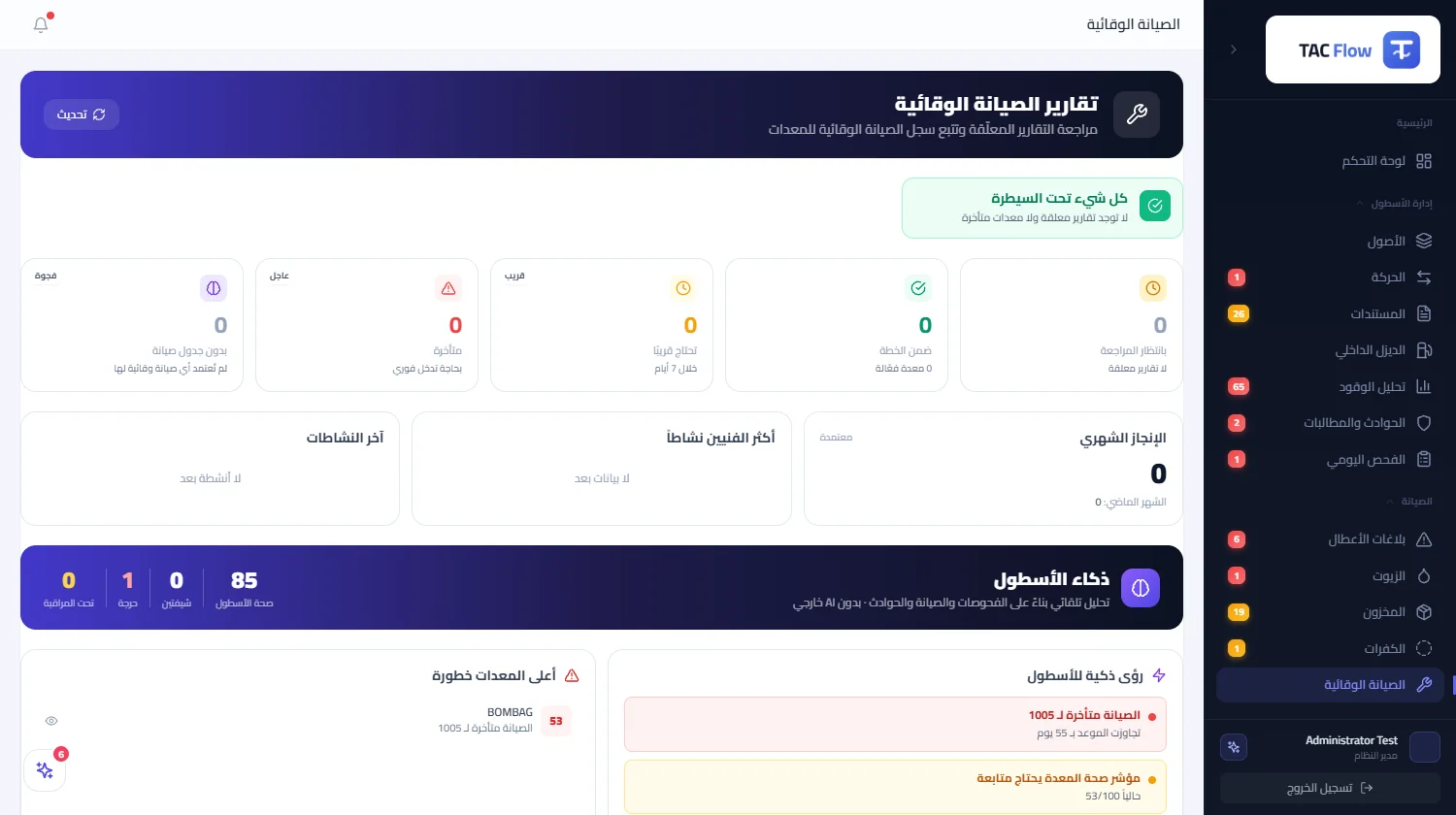
Preventive Maintenance
Screen of Preventive Maintenance
From the field, no account

One code on the asset opens all of this

The technician or driver scans the code printed on the asset and a public page opens in four languages — they submit directly, with no account and no app, and the entry lands on the asset record instantly.

  • A four-language interface, with free text auto-translated
  • A draft that never dies: saved on-device and restored even after a network drop or a closed browser
  • Duplicate-proof submission, with ID numbers shown masked
Try the asset search

What gets recorded from this page for this module

Straight from the work site

  • Maintenance report with photos and the reading
The flow

How the process runs end to end

  1. 01

    Setup

    Task intervals are entered per asset — mandatory

  2. 02

    Alert

    Approaching due dates show on the machine’s card and the reports

  3. 03

    Execution

    A maintenance report from the field with photos and the reading

  4. 04

    Reschedule

    Approving the report sets the next due date from its reading

After rollout

What actually changes

No promises built on numbers we don’t know about your company. What follows is the structural difference of wiring this module into the rest of the platform.

Less downtime
planned instead of sudden
Longer life
for the asset and its components
Honest scheduling
no date built on an assumption

Limits of this module

There is no default maintenance interval in the system: intervals are entered as mandatory, and without them the asset shows “Needs setup” rather than being wrongly scheduled. A task that doesn’t apply to the equipment type never gets a fabricated schedule.

Try Preventive Maintenance on your own assets — not a generic example

We tailor the demo to your operation, starting with the module that blocks your team today.