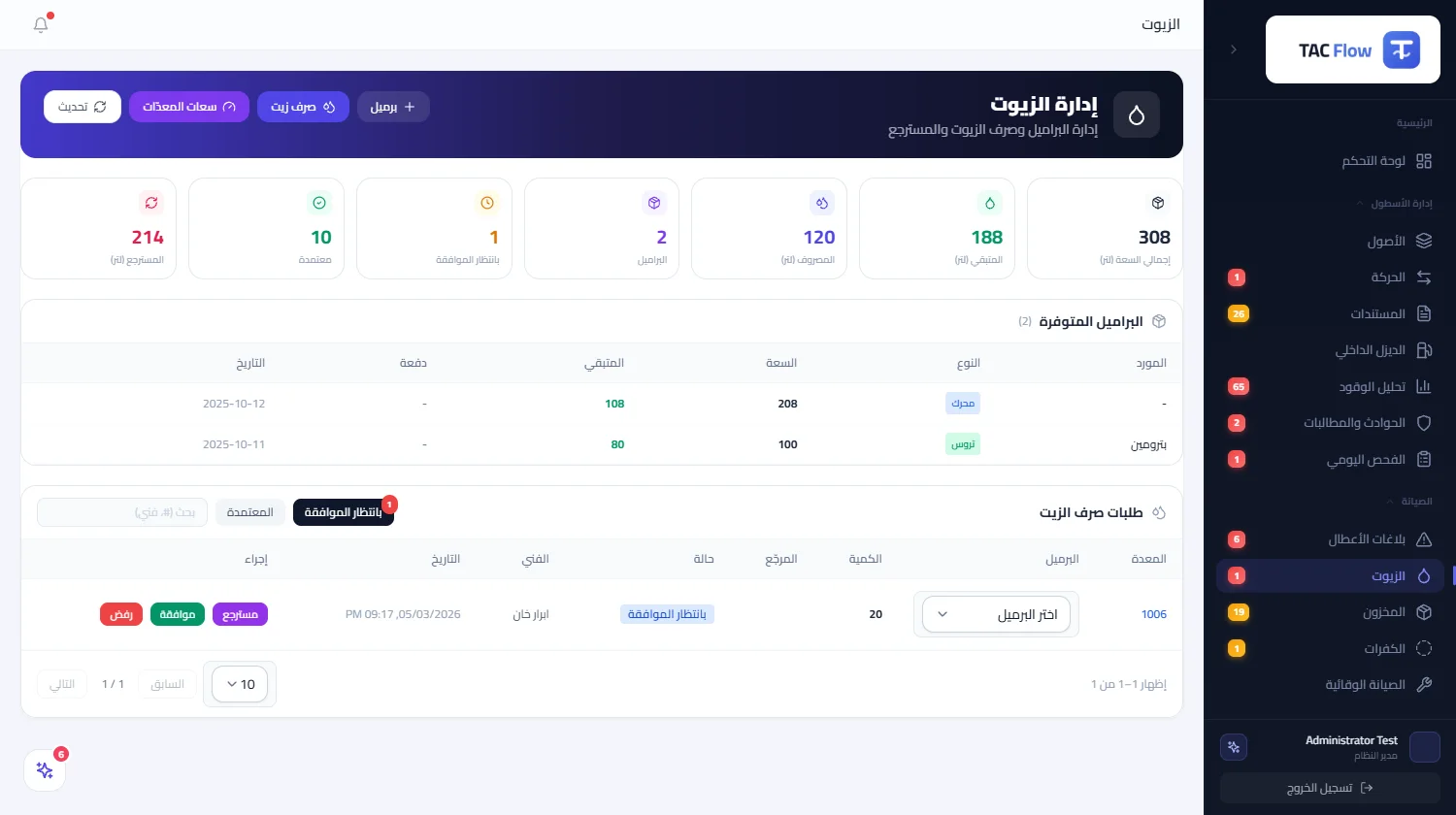
Inside the service
In most workshops the oil barrels are an open trust: technicians draw what they see fit, the barrel runs dry with no account of where its liters went, and the used oil disappears even though it sells for real money. This module closes the loop at both ends: dispensing starts as a request and only an authorized approval deducts from the barrel, and the used-oil return is a precondition of approval rather than a courtesy after it — with an expected return of roughly ninety-five percent booked back into inventory.
01
Request first, approval deducts
The technician submits a dispensing request with the type, quantity and machine, and the request stays pending until someone holding the maintenance-approval capability — not mere entry rights — approves it. Recording is one thing, deciding another. The approval alone is what deducts from the selected barrel, after a check that its balance suffices: no dispensing precedes its decision, and no barrel's level drops on a spoken word.
02
A capacity check before deciding
A quantity exceeding the machine's engine-oil capacity by a reasonable margin is flagged automatically at request time, and at approval it passes only with a written override reason recorded on the transaction. An illogical quantity is either a typing error to correct or a leak worth a question — and either way, the decision and its reason stay stamped in the record for whoever reviews later.
03
The return is a condition
Dispensed oil pushes the old oil out of the engine, and the system expects roughly ninety-five percent of the quantity to come back. It refuses to approve the dispensing at all before the used oil's receipt is recorded and meets the expected threshold. At the moment of receipt, the used oil is automatically booked as its own inventory item through a documented inbound movement — turning it from a liquid that vanishes behind the workshop into visible stock that sells and recovers its price.
04
Locked into incidents and cost
An oil transaction linked to a fault report enters that report's closing gate: a report carrying an unapproved oil issue, or used oil not yet received, cannot be closed until the transaction is resolved — no deferred settlement gets forgotten after the file closes. The cost lands on the machine and appears in its history beside its parts and its faults, and every barrel's level, location and status stays readable at any moment.