- Names used in Saudi Arabia
- Pallet truckHand pallet truckPallet jackPump truckRafi‘a yadawiyya (Saudi term)
- Formal name
- عربة منصات يدوية
- English name
- Hand pallet truck
- Family
- Heavy equipment · Material handling
- Measured by
- No meter
01Definition and uses
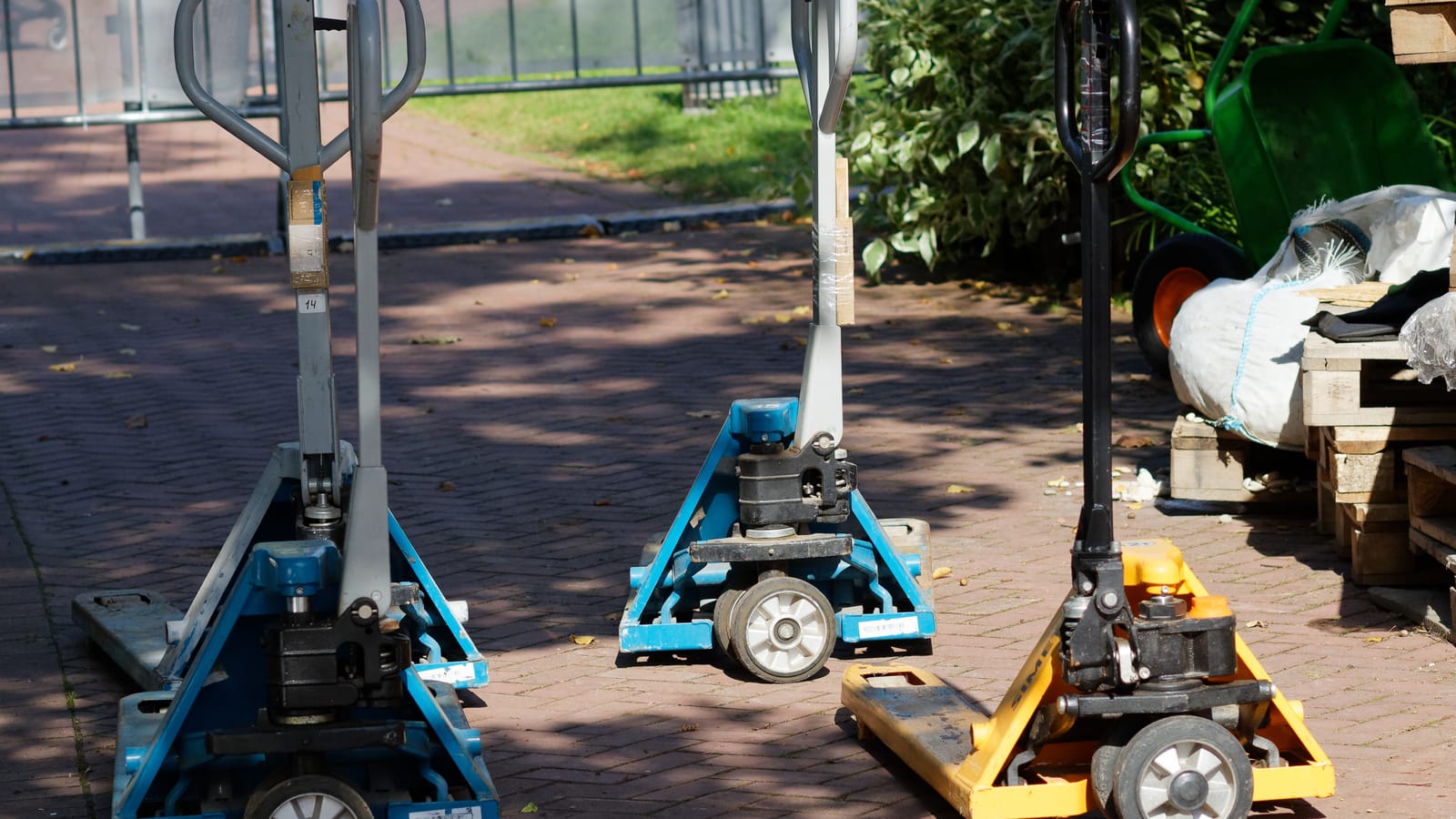
The pallet truck is a tool for lifting and moving wooden pallets, counted the simplest form of forklift, and it is used to move loads stacked on pallets inside warehouses, distribution centres, shops and construction sites. Its two forks are slid under the pallet, and it is steered by a tiller-like arm that at the same time works the piston of a hydraulic pump that raises the two forks, and with a small handle on the arm the fluid is released so that they lower. It lifts the pallet only enough to clear the ground, so it is a transport machine and not a stacking machine. In the TAC Flow system it is registered under the name “rafi‘a yadawiyya” (hand pallet truck) in the list of equipment types. It differs from the “forklift”, which carries pallets to a height and needs an operating licence.
Uses
- Moving pallets inside warehouses from the receiving area to the racks.
- Arranging and moving pallets inside a truck trailer when no forklift is available.
- Supplying shops and distribution centres with stacked goods.
- Moving packaged materials inside construction sites on prepared ground.
- Loading small trucks and trailers from level docks.
- Handling in factories between production lines and stores.
02Classes and sizes
They are classified by the type of drive, the fork dimensions and the rated capacity marked on the plate, and the capacity is not estimated by opinion but read from the model plate.
| Class | Description | Typical use |
|---|---|---|
| Manual | Lifting by a hydraulic pump worked with the tiller, and pulled by the worker’s hand | Shops, personal stores and sales centres. |
| Electric | Driven by an electric motor with a speed control handle, and some have a platform for the operator to stand on | Heavier pallets, longer distances and stacked loads. |
| Rough terrain | A strong frame and durable pneumatic tyres | Uneven ground on work sites. |
Standard dimensions are common: the width of each fork 180 mm, the width of the machine between the outer edges 510 or 690 mm, the fork length 910, 1070 or 1220 mm, and the fork height when lowered 74 mm.
03Main components
- 01The two forks and their reinforced cover.
- 02The steering tiller and the lift and lower control handle.
- 03The hydraulic pump cylinder, its piston and the fluid reservoir.
- 04The steering wheels under the tiller.
- 05The front wheels inside the fork tips and the push rods that move them.
- 06The linkage and springs that carry the pump motion to the wheels.
- 07On the electric model: the battery, the charger, the motor and the safety switch.
- 08The capacity plate marked on it.
04Periodic maintenance schedule
The hand pallet truck has no meter, and the electric one has an hour meter on some models, so its schedule is built on time and intensity of use, not kilometres. The following ladder is the usual one, and the manual for the specific model sets the intervals and tasks that apply; the intervals are shorter in dusty warehouses and when the machine runs two shifts.
| Interval | Typical tasks |
|---|---|
| Daily before use |
|
| Weekly |
|
| Monthly |
|
| Every 3 months |
|
| Every 6 months |
|
| Annually |
|
The manufacturer’s manual governs. The actual intervals and tasks are set by the operation and maintenance manual for your machine’s model, and they are shortened in heavy dust, high heat and continuous operation. This table shows the general order only and does not replace the manual.
05Daily pre-start checklist
10 items
The general reference for handling equipment requires operators to be trained, and acknowledges that heavy loads make the risk of injury great.
06Common operating mistakes that cause breakdowns
- Loading more than the rated capacity, so the forks bend and the pump is damaged.
- Inserting the forks into an unsuitable pallet, since reversible pallets or those whose boards obstruct the wheels are not suitable.
- Pushing fast on uneven ground or on sand and gravel, so the wheels shatter unless they are rough-terrain wheels.
- Leaving the forks raised and loaded unnecessarily, so the pump seal wears.
- Dragging a heavy load on a slope or pushing it without braking on the electric model.
- Pulling at a strong side angle instead of standing behind the tiller in a straight line.
- Neglecting wheels wound with plastic wrapping and wires, so the axle heats up.
- Using it to lift people or to stand on, since it is designed to move pallets only.
07Regulatory requirements
Regulatory procedures to check when owning or operating this machine in the Kingdom.
08What to weigh when renting or buying
- The rated capacity against the heaviest pallet, and the fork width and length against your pallets.
- The drive type: manual for light and intermittent use, and electric for long distances and heavy loads.
- The condition of the pump: lifting with no gradual sinking, and free of leaks.
- The condition of the wheels and their type according to the floor: a smooth warehouse or an open site.
- On the electric model: the battery age, the suitability of the charger and the availability of spare parts.
- When renting: the rental period and the delivery of the charger with the electric model, and who bears the damage caused by misuse.
Settle these factors first, then enter your own numbers in the Own vs rent calculator or the Equipment operating cost per hour calculator.
09Frequently asked questions
A hydraulic tool with two forks that lifts the pallet a little to move it inside the warehouse, and it is known by the general name “pallet jack”.
The pallet truck moves the pallet at a very low height by hand power or a small motor, while the forklift lifts the load to a height, stacks pallets and needs an operating licence. The hand pallet truck is counted the simplest form of forklift.
The capacity on its plate, the fork dimensions, the condition of the pump and the wheels and the rental period, and on the electric model the battery and the charger, as in the rental section above.
Training on handling equipment is a general condition and is stressed for electric models for their weight and lifting power, and the Saudi requirement by name is in the requirements section above.
Ordinary models are for smooth ground, and for uneven ground there are models with a strong frame and durable pneumatic tyres.
The manual for short moves, light loads and intermittent use, and the electric for longer distances, heavier pallets and stacked loads.
The usual cause is a fault in the pump or its seal, a lack of fluid or the release valve, and they are inspected as in the maintenance table.
The fork wheels extend to the floor and catch on pallets whose boards do not let them pass, and they can enter from only two directions in a four-way pallet with notched stringers, and reversible pallets are not suitable.