- Names used in Saudi Arabia
- Reach stackerContainer reach stackerContainer handlerPort container lifterReach stacker (Saudi term)
- Formal name
- رافعة حاويات
- English name
- Reach stacker
- Family
- Heavy equipment · Material handling
- Measured by
- Operating hours
01Definition and uses
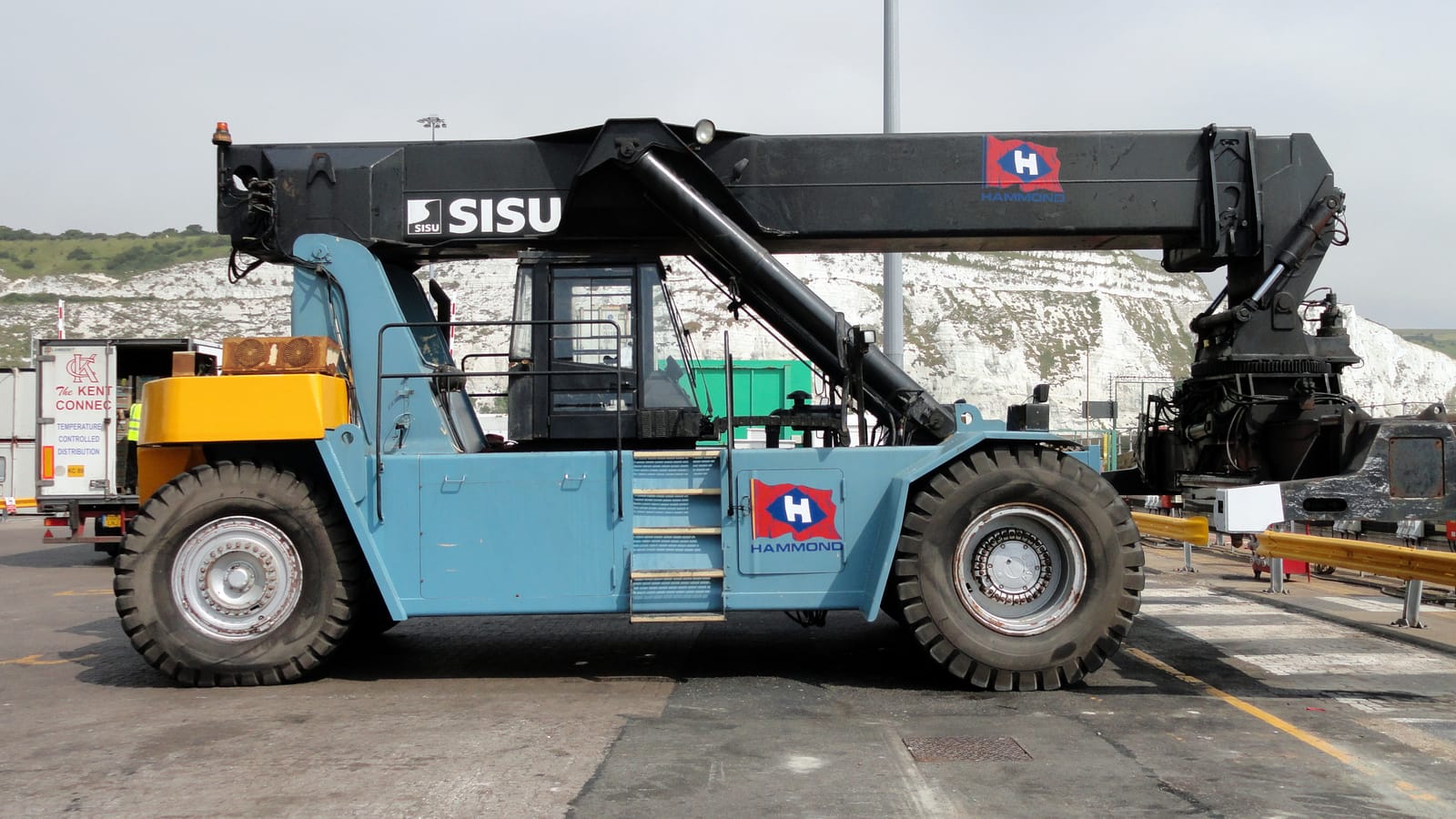
The reach stacker is an intermodal container handling vehicle inside ports and terminals, moving the container short distances quickly and stacking it in rows according to their accessibility. It has advanced on the forklift in container handling through its flexibility and the stacking and storage capacity it allows, keeping container blocks four rows deep because of reaching the second row. It is measured in operating hours. It is not the narrow-aisle warehouse forklift called the reach truck, since that is for warehouse racks and this is for containers.
Uses
- Loading containers from trains onto trucks and vice versa.
- Stacking containers in port yards and dry ports.
- Handling empty containers with attachments dedicated to them.
- Handling flat-rack containers carrying special loads, such as a small boat on a flat rack.
- Moving containers short distances inside the yard between the gate and the stack.
- Handling containers in logistics company yards.
- Loading containers onto trailers from large warehouse docks.
02Classes and sizes
Classes vary by the maximum load the machine lifts, the number of rows of reach and the stacking height, and the container sizes it handles. Most containers in the world are either twenty feet or forty feet long, and the machine is chosen to lift the heaviest loaded container in your work.
| Class | Description | Typical use |
|---|---|---|
| Reach stacker for loaded containers | A telescopic boom and a spreader with rotating locks that enter the container corners | Stacking and loading in ports. |
| Empty container handler | A machine dedicated to empty containers | Quick depositing of empties in yards. |
| Deep-stacking reach stacker | Reach to the second row | Tight yards and high density. |
| Electric reach stacker | Runs on an electric motor instead of diesel | Places that require lower emissions. |
| Multi-purpose reach stacker | A design that combines elements of the forklift | Yards that need handling of containers and goods together. |
03Main components
- 01The chassis and the cab, which can sometimes be raised for better visibility.
- 02The engine, the transmission and the axles with large tyres.
- 03The telescopic boom and the lift and extension cylinders.
- 04The spreader, which is a frame with rotating locks that enter the openings of the container corners.
- 05The corner locks and the grip confirmation sensor.
- 06The load moment indicator and the tilt sensors.
- 07The counterweight at the rear.
- 08The hydraulic system: pumps, valves and tank.
- 09The brake and steering system.
- 10The cameras, the mirrors and the reverse alarm.
04Periodic maintenance schedule
The usual ladder, and the model manual sets the intervals and tasks that apply; the intervals are shorter in high heat, dust, humidity and salt in ports.
| Interval | Typical tasks |
|---|---|
| Every 10 hours / daily |
|
| Every 50 hours / weekly |
|
| Every 250 hours |
|
| Every 500 hours |
|
| Every 1000 hours |
|
| Every 2000 hours |
|
The manufacturer’s manual governs. The actual intervals and tasks are set by the operation and maintenance manual for your machine’s model, and they are shortened in heavy dust, high heat and continuous operation. This table shows the general order only and does not replace the manual.
05Daily pre-start checklist
14 items
The general reference for industrial vehicles at port terminals requires them to be kept fit for safe operation, not to be operated if they have a fuel leak or any safety defect, and that their brakes are sound and their rated load is visible to the operator.
06Common operating mistakes that cause breakdowns
- Lifting a container whose weight exceeds that marked on it or the capacity of the machine, which is prohibited in the reference regulation.
- Moving with the container raised high or the boom extended instead of lowering and retracting it.
- Slewing or sudden braking with a raised load.
- People under the suspended container, and the regulation requires keeping them away.
- Not making sure the corner locks have gripped before lifting.
- Going up or down a slope at speed, and not slowing at junctions of aisles with blocked visibility.
- Stacking on sloping or soft ground.
- Leaving the machine without braking and with a raised spreader.
07Regulatory requirements
Regulatory procedures to check when owning or operating this machine in the Kingdom.
08What to weigh when renting or buying
- The maximum load in the first and second row against the heaviest container you handle.
- The stacking height and the number of rows required.
- The condition of the telescopic boom, its slide pads and clearance.
- The condition of the spreader, its locks and its sensors.
- The soundness of the load moment indicator, its calibration and the date of the last inspection.
- The validity of the lifting equipment inspection certificate.
- The condition of the tyres and the percentage of tread remaining.
- The engine hours with the maintenance record and leaks.
- When renting: who provides the licensed operator, who bears the insurance, the transport and the tyres, and how hours are counted.
Settle these factors first, then enter your own numbers in the Own vs rent calculator or the Equipment operating cost per hour calculator.
09Frequently asked questions
In the Saudi market it is also said “reach stacker”. The English name is in the name field above, and its equivalent in Arabic is “rafi‘at al-hawiyat” (container lifter).
The reach stacker is dedicated to containers with a boom that extends and stacks to a greater depth, and it has advanced on the forklift in ports through its flexibility and stacking capacity.
It is not a fixed port crane; the quay crane loads ships and stays in its place, and the reach stacker is a mobile vehicle that moves containers in the yard.
Ship-to-shore container cranes, rubber-tyred gantry cranes, straddle carriers, the reach stacker, side loaders and terminal tractors.
The reach truck is a narrow-aisle warehouse lift for goods racks, and the reach stacker is for containers in open yards.
Container blocks remain four rows deep thanks to reaching the second row.
By a container trailer that carries the container on a tractor head, and the crane lowers it in the port yard.
The brakes, the leaks, the tyres, the boom, the spreader and its locks, the moment indicator and the alarms, as in the list above.