- Names used in Saudi Arabia
- Scissor liftScissor platformMobile elevating work platformMEWPScissor lift (Saudi term)Rafi‘a miqassiyya
- Formal name
- منصة رفع مقصية
- English name
- Scissor lift
- Family
- Heavy equipment · Access platforms
- Measured by
- Operating hours
01Definition and uses
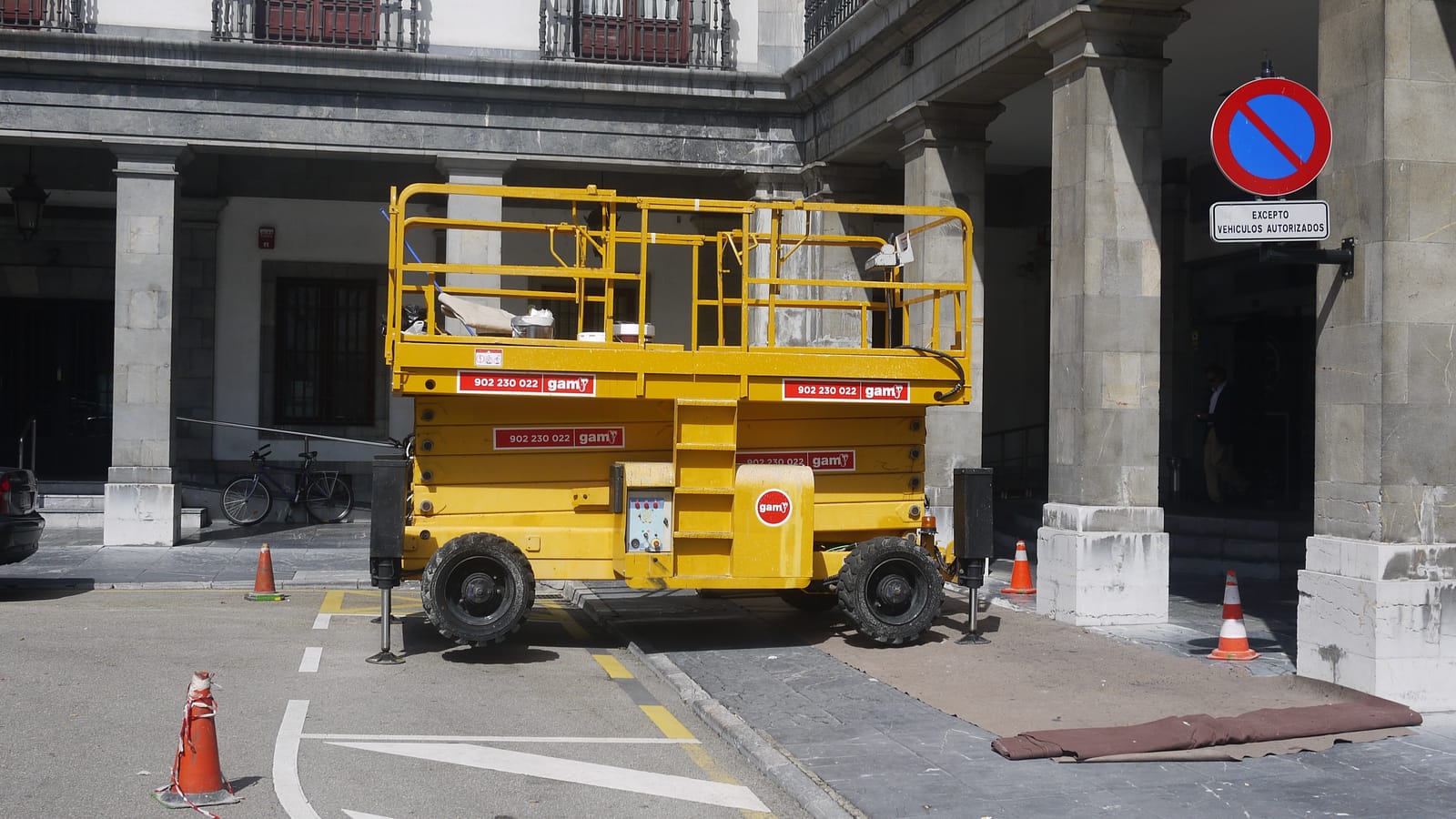
The scissor lift is a lifting platform that carries workers and their tools to a height, and it usually moves vertically by a mechanism of crossed supports in the shape of the letter X called the scissor, where pressure is applied to the outer side of the bottom set of supports so they extend and push the platform upward. It belongs to the family of elevating work platforms that give temporary access to high places for maintenance and construction work, it usually carries less than a tonne, and one person is enough to operate and set it up. It is measured in operating hours. In the Saudi market “scissor lift” and “rafi‘a miqassiyya” are said, and it differs from the “boom lift” with an arm in that it mostly raises its platform vertically.
Uses
- Electrical installation, lighting and air-conditioning work on high ceilings.
- Painting, and fitting boards and plasterboard in buildings.
- Installing panels, cables, pipes and mechanical work at height.
- Temporary maintenance and construction work at heights.
- Maintenance of warehouses, factories and airports and cleaning ceilings.
- Interior construction work on floors and steel structures.
- Exhibitions and events, in installing lighting and decorations.
02Classes and sizes
Scissor platforms are classified by working height, width, capacity, power source and tyre type, and these are manufacturer data for each model and are marked on the plate. The most important operating difference is between the small electric one for smooth interior floors and the larger diesel one for rough ground.
| Class | Description | Typical use |
|---|---|---|
| Electric with small tyres | Charged from an ordinary electrical outlet, with almost no fuel emissions | Interior work and level floors. |
| Diesel rough terrain | Large tyres with high ground clearance | Outdoor sites and uneven ground. |
| With extended platform | An extra deck that extends forward to bring the worker closer to the work | Work that needs side reach. |
| Vertical mast platform | A mast that lifts a one-person platform, suited to narrow doors | Lighting and signs in tight spaces. |
03Main components
- 01The scissor: the sets of crossed supports with their joints and pins.
- 02The hydraulic lift cylinder or the screw or rack-and-pinion mechanism.
- 03The platform, its guardrail, the entry gate and the platform extension.
- 04The side outriggers on larger models.
- 05The control panel on the platform, and the lower control panel for emergency lowering.
- 06The manual valve for emergency lowering when power is lost.
- 07The chassis, the axles, the tyres and the drive motor.
- 08The batteries and the charger on the electric model, or the diesel engine.
- 09The sensors: tilt, load and the audible alarm, and pothole guards on some models.
04Periodic maintenance schedule
The following ladder is the usual one, and the manual for the specific model sets the intervals and tasks that apply; the intervals are shorter in dusty outdoor work and for platforms that work daily.
| Interval | Typical tasks |
|---|---|
| Every 10 hours / daily |
|
| Every 50 hours / weekly |
|
| Every 250 hours |
|
| Every 500 hours |
|
| Every 1000 hours |
|
| Every 2000 hours |
|
In addition, documented periodic inspections are carried out by a qualified body according to the local regulation, and their certificate is kept with the platform’s record.
The manufacturer’s manual governs. The actual intervals and tasks are set by the operation and maintenance manual for your machine’s model, and they are shortened in heavy dust, high heat and continuous operation. This table shows the general order only and does not replace the manual.
05Daily pre-start checklist
13 items
The regulation on vehicle-mounted aerial platforms requires the controls to be tested daily before use, that only authorised persons operate it, and that the load limits declared by the manufacturer are not exceeded, and it is a reference standard by which scissor platforms are judged.
06Common operating mistakes that cause breakdowns
- Loading the platform above its capacity; the weight of the workers, tools and materials is counted together.
- Operating on sloping or soft ground or ground with gaps.
- Standing on the platform guardrail, climbing its edge or using a ladder or boards on it to extend reach.
- Moving the platform while raised in models whose manual does not allow it.
- Working under or near power lines without a safe clearance.
- Leaving the platform raised with no workers, or lowering it with sudden force that hits the scissor.
- Pressing the lower lowering switches without permission from the worker on the platform.
- Ignoring an oil leak or a delay in the scissor’s lifting on the pretext of finishing the job.
07Regulatory requirements
Regulatory procedures to check when owning or operating this machine in the Kingdom.
08What to weigh when renting or buying
- The working height required and the platform width against the doors, aisles and lifts.
- Electric for clean interiors and diesel for outdoors and rough ground.
- The rated load against the workers and the tools together.
- The condition of the scissor, joints and cylinders for cracks and leaks.
- The age of the batteries and the soundness of the charger on the electric model.
- A valid inspection certificate, the maintenance record and the hour-meter reading.
- The working of the emergency lowering valve, the sensors and the alarms.
- When renting: whether it comes with a qualified operator, and who bears the charging, the fuel, the transport, the insurance and damage to the platform.
Settle these factors first, then enter your own numbers in the Own vs rent calculator or the Equipment operating cost per hour calculator.
09Frequently asked questions
A vertical lifting platform with a scissor mechanism that carries one or more workers with their tools to a height for temporary work.
The scissor mostly raises its platform vertically, while the boom lift is an arm of articulated or telescopic sections that extends in several directions and reaches beyond obstacles.
The working height, the load, the platform width, the power type, the inspection certificate, and who bears the charging and the insurance, as in the rental section above.
The electric for level ground indoors with almost no emissions, and the diesel with large tyres for uneven ground outdoors.
The platform is lowered by a manual valve that releases the hydraulic or air pressure in the models prepared for it, so it descends without power. The operator’s knowledge of the valve’s location is part of the daily inspection.
The controls, the ground, the outriggers, the capacity, the guardrail, the oil leak, the batteries and the emergency lowering, as in the list above.