- Names used in Saudi Arabia
- TelehandlerTelescopic handlerTelescopic forkliftRough terrain telehandlerTelehandler (Saudi term)Rafi‘a tilskubiyyaRafi‘a shawkiya tilskubiyya
- Formal name
- رافعة تلسكوبية متعددة الأغراض
- English name
- Telehandler
- Family
- Heavy equipment · Lifting & handling
- Measured by
- Operating hours
01Definition and uses
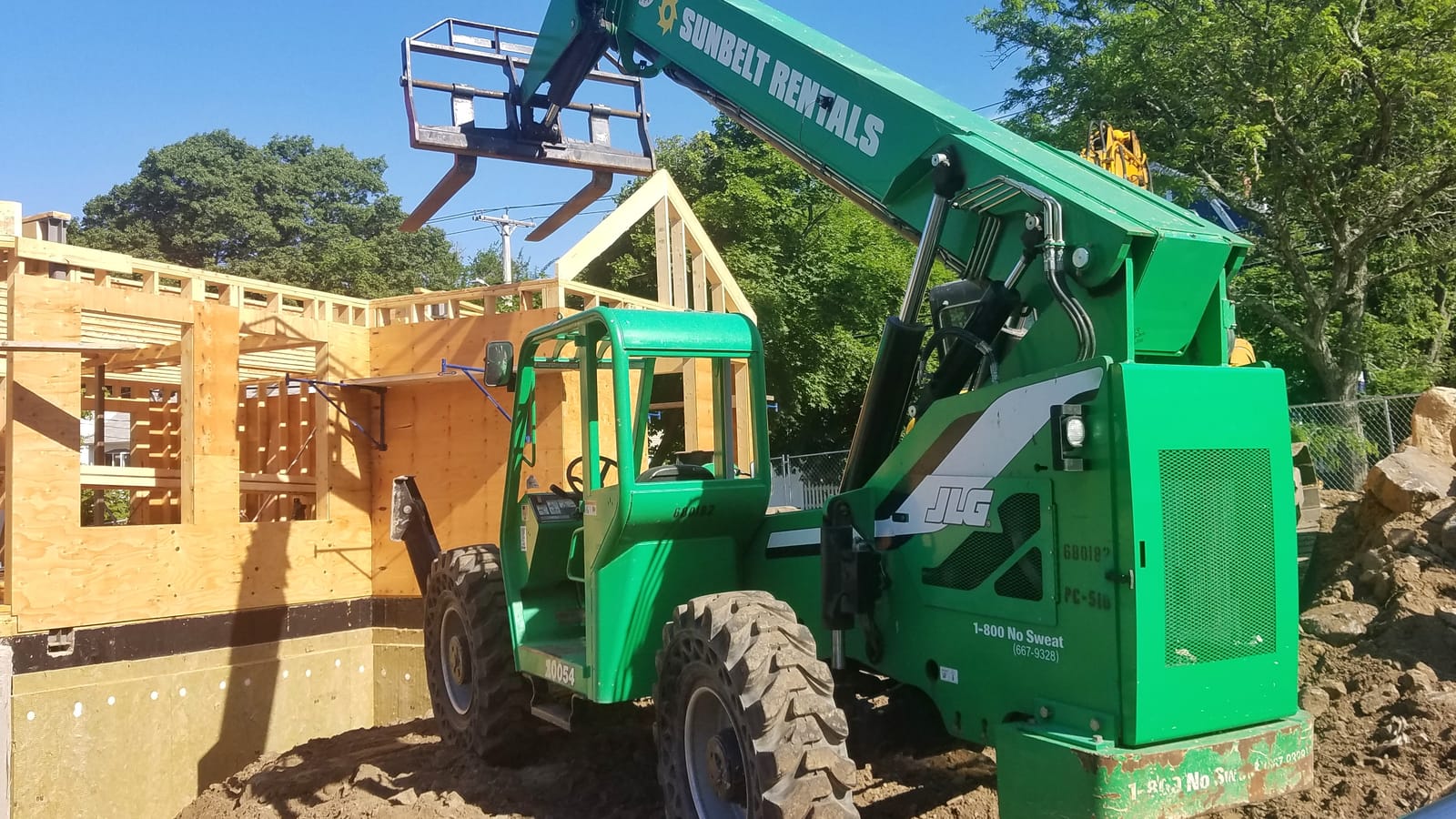
The telehandler is a handling machine resembling the forklift but with a telescopic boom that extends forward and upward from the vehicle, so it combines the forklift and the crane, and various attachments such as forks, a bucket, a hook, a winch and a basket are fitted on the boom. It is also called the telescopic handler, and it is said that the first was made by a French company in 1957, then it spread after JCB launched its “Loadall” model in 1977. It is measured in operating hours. In the Saudi market it is sold and rented under the names “telehandler” and “telescopic lift”, and buyers call it “telescopic forklift”. It is not the wheel loader, since the wheel loader is a bucket loading machine, and not the crane, because the boom on it does not rotate in most models.
Uses
- Lifting pallets and materials to roofs and upper floors in place of the crane when it is not available.
- Unloading pallets from inside the trailer and reaching what the ordinary forklift cannot reach.
- Loading heavy building materials onto scaffolds and structures.
- Working with the bucket to load grain and loose materials on farms.
- Reaching high-sided trailers and hoppers.
- Lifting workers with an approved basket fitted on the boom, which is then classified as an elevating work platform in some regulations.
- Handling work on construction sites, in factories and in quarries.
02Classes and sizes
Telehandlers are classified by maximum lift height, maximum load, reach radius and the type of structure: fixed boom or rotating. All are manufacturer figures for each model, and the figure that applies is that in the load chart for the boom position and the attachment. Lifting capacity falls quickly as the reach radius increases, and the same machine may carry a large load with the boom retracted and very little once it is fully extended.
| Class | Description | Typical use |
|---|---|---|
| Small and narrow | A compact machine with limited lift height | Warehouses, farms and interior work. |
| Medium | The most widespread on construction sites | Lifting materials to floors and roofs. |
| High reach | A long boom and great lift height | Tall buildings and industrial structures. |
| Rotating with outriggers | An upper structure that rotates 360 degrees with outriggers lowered before lifting | Close to a small crane in use. |
03Main components
- 01The telescopic boom with its sections, slide blocks, extension chains and their hoses.
- 02The lift, extension and tilt cylinders.
- 03The quick attachment coupler and the fork carriage.
- 04The attachments: forks, bucket, hook, winch and basket.
- 05The engine, the hydrostatic transmission and the axles with four driven and steered wheels.
- 06The hydraulic system: pump, control valves, tank and cooler.
- 07The front outriggers fitted on some models.
- 08The cab, the rollover protective structure and the seat belt.
- 09The load moment indicator and the motion cut-out at the limit, which is mandatory in Europe.
- 10The load chart plate in the cab.
04Periodic maintenance schedule
The following ladder is the usual one, and the manual for the specific model sets the intervals and tasks that apply; the intervals are shorter in dust and repeated lifting with loads near the limit.
| Interval | Typical tasks |
|---|---|
| Every 10 hours / daily |
|
| Every 50 hours / weekly |
|
| Every 250 hours |
|
| Every 500 hours |
|
| Every 1000 hours |
|
| Every 2000 hours |
|
In addition, documented periodic inspections of lifting equipment are carried out by a qualified body according to the local regulation.
The manufacturer’s manual governs. The actual intervals and tasks are set by the operation and maintenance manual for your machine’s model, and they are shortened in heavy dust, high heat and continuous operation. This table shows the general order only and does not replace the manual.
05Daily pre-start checklist
14 items
06Common operating mistakes that cause breakdowns
- Lifting outside the load chart by extending the boom far with a heavy load, so capacity falls quickly and the machine becomes more liable to overturn.
- Driving with the boom raised or extended instead of folding it close to the ground.
- Operating on sloping or soft ground or ground with gaps.
- Using the hook or winch as if it were a crane, without an approved attachment and without calculating the radius.
- Lifting workers on the forks or in an improvised box instead of an approved basket made for this purpose.
- Sharp braking and steering with the load high.
- Neglecting the front outriggers when the load requires them.
- Working near overhead power lines without a safe clearance.
07Regulatory requirements
Regulatory procedures to check when owning or operating this machine in the Kingdom.
08What to weigh when renting or buying
- The maximum height, radius and weight you will need, compared with the load chart and not the nominal figure.
- The condition of the boom: the slide blocks and their clearance, cylinder leaks, and the soundness of the chains.
- Boom shake or sag on extension, and the transmission performance.
- The load indicator and the motion cut-out working, with no disabling.
- The attachments available, the type of quick coupler and its match to your equipment.
- The condition of the tyres and the percentage of tread remaining.
- The operating hours with the maintenance record and a valid inspection certificate.
- When renting: whether it comes with a qualified operator, which attachments are included, and who bears the fuel, the tyres and the transport.
Settle these factors first, then enter your own numbers in the Own vs rent calculator or the Equipment operating cost per hour calculator.
09Frequently asked questions
The forklift lifts pallets vertically in front of the mast and suits level ground, while the telehandler extends its boom forward and upward and reaches what the forklift cannot, but its capacity falls quickly with extension.
A name in use in the market for the telehandler because it combines forks and a telescopic boom.
The telehandler is closer to the forklift with a boom that mostly does not rotate, and the telescopic crane is a lifting machine with load charts and full support; and the rotating models fixed with outriggers are counted as a hybrid between the telehandler and the small crane.
It differs by model, and the figure that applies is what the load chart sets for the boom position and the attachment, so consult the model plate and not the advertisement.
The boom, the slide blocks, the cylinders, the load indicator, the operating hours, the maintenance record and the tyres, as in the buying section above.
The oils, the leaks, the boom, the attachment, the load chart, the load indicator, the tyres, the brakes and the outriggers, as in the list above.