- Names used in Saudi Arabia
- Curtain-side trailerCurtainsiderTautlinerCurtain-sided semi-trailerTareela sitara (Saudi term)
- Formal name
- نصف مقطورة بستائر جانبية
- English name
- Curtain-side semi-trailer
- Family
- Trucks & trailers · Trucks
- Measured by
- Kilometres
01Definition and uses
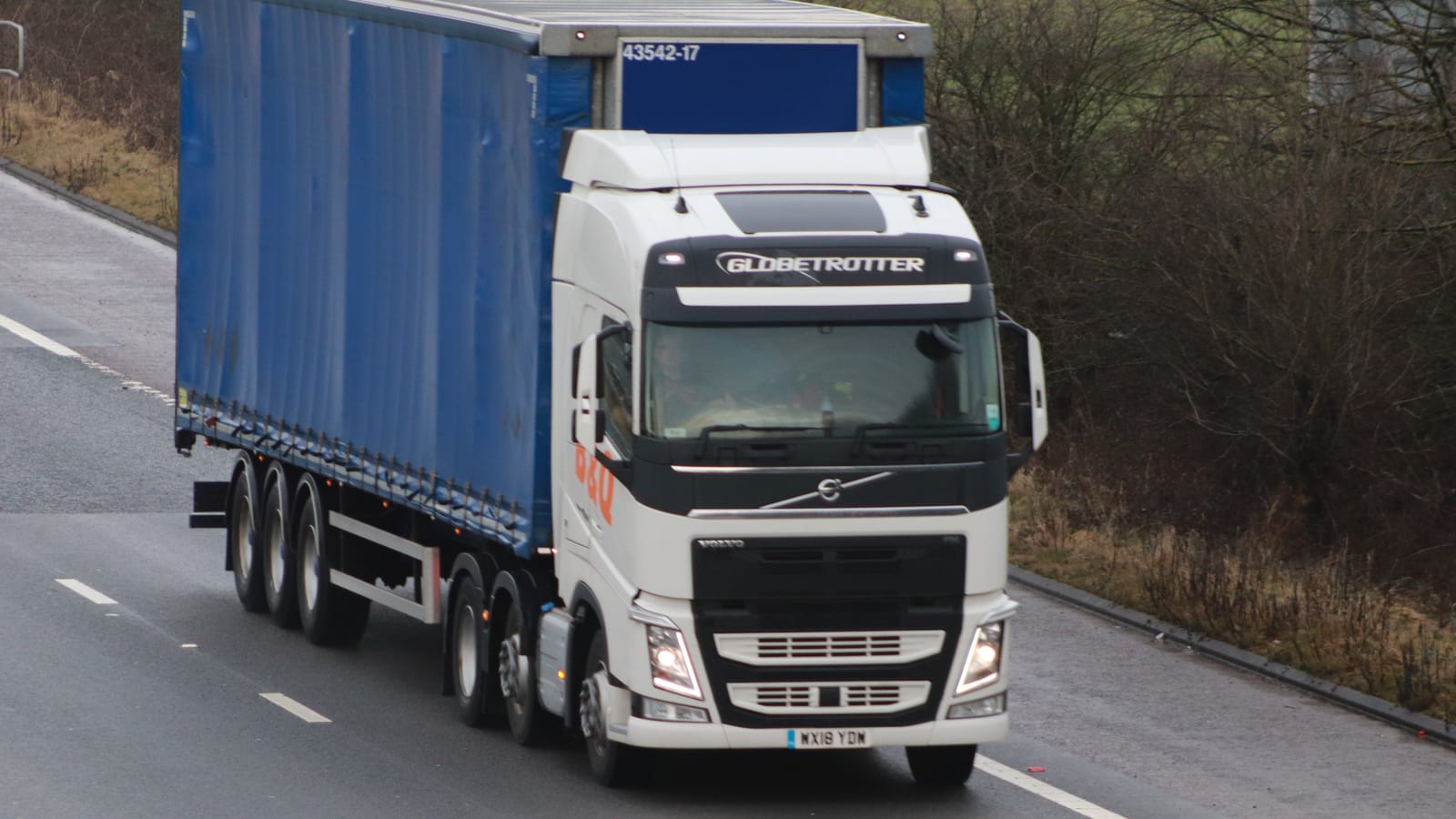
The curtain-side trailer is a semi-trailer with a flat floor whose two sides are curtains fixed by an upper rail and removable front and rear posts, so the curtains are drawn and goods are loaded and unloaded from the side by forklift along the length of the trailer instead of only through its rear door. In English references it is called a “tautliner” and a “curtain-sider”, the first being a trade name of a British maker that became a generic name for the type. It is a road trailer with no engine, pulled by a tractor head, so its maintenance is measured by the kilometres covered together with time. In the Saudi market “tareela sitara” is said for the trailer with curtains, and it differs from the open “tareela satha” with no curtains and no walls, and from the closed refrigerated “barrad”.
Uses
- Carrying goods stacked on wooden pallets between cities and warehouses.
- Loading and unloading from the side by forklift when the rear door cannot be reached.
- Carrying packed building materials such as sacks, tiles and wrapped packages, with protection from dust.
- Carrying consumer goods and dry packaged food.
- Carrying furniture, household appliances and wrapped light equipment.
- Linking production sites to distribution centres on fixed schedules.
02Classes and sizes
The curtain-side trailer is classified by its length, number of axles, suspension type and the height of the floor and roof, and the permitted lengths and weights of each trailer are set in its registration card and by road regulations, so no general figure is relied on. The curtains have a defined restraint capacity per metre of length, provided the load is placed within a set distance of the curtain, and the manufacturer declares the limit that applies.
| Class | Description | Typical use |
|---|---|---|
| Three-axle curtain-side | The most widespread trailer in transport between cities | Goods stacked on pallets between warehouses. |
| High-roof curtain-side | A greater internal height for a wider loading volume | Light bulky goods such as furniture and packages. |
| Sliding-roof curtain-side | A roof that opens for loading the goods from above | Goods loaded by overhead cranes. |
03Main components
- 01The chassis, the timber or metal floor and its cross members.
- 02The reinforced fabric curtains with their ropes and rings.
- 03The upper rail on which the curtains are fixed and slide.
- 04The removable front and rear posts.
- 05The tensioning winches that stop the curtains flapping in the wind.
- 06The vertical lashing straps and the rope rail under the floor.
- 07The axles, the suspension, the air brakes and their hoses.
- 08The kingpin and its ground supports.
- 09The lighting, the reflectors and the electrical connector with the head.
04Periodic maintenance schedule
The trailer has no engine, so its schedule is built on kilometres covered and time, and the maintenance of the tractor head that pulls it is added. The following ladder is the usual one, and the manual for the specific model sets the intervals and tasks that apply; the intervals are shorter on dusty roads and with repeated heavy loads.
| Interval | Typical tasks |
|---|---|
| Daily before moving |
|
| Weekly |
|
| Every 10,000 km or per the manual |
|
| Every 20,000 km |
|
| Every 40,000 km |
|
| Every 80,000 km or annually |
|
The manufacturer’s manual governs. The actual intervals and tasks are set by the operation and maintenance manual for your machine’s model, and they are shortened in heavy dust, high heat and continuous operation. This table shows the general order only and does not replace the manual.
05Daily pre-start checklist
13 items
The general reference for commercial vehicles requires the driver to make sure before driving of the soundness of the brakes, including the trailer brake connections, the steering, the lighting and reflectors, the tyres, the horn, the wipers, the mirrors, the coupling devices, the rims and the emergency equipment.
06Common operating mistakes that cause breakdowns
- Relying on the curtain alone to secure a heavy load, since its capacity is limited per metre and by the load’s nearness to it.
- Leaving the curtains untensioned, so they flap in the wind and tear.
- Loading from one side or from the front only, which upsets the balance and wears the tyres of one side more than the other.
- Exceeding the declared axle weight, so the brakes and suspension suffer and the truck is liable to a violation.
- Driving with the ground supports not fully raised or the curtains not closed.
- Neglecting to drain the water from the air tanks, so the brake valves are damaged.
- Loading with a forklift when the trailer is not supported or on uneven ground.
- Opening the curtains on the road or at an unsafe stop to check the load, which exposes the goods and the workers to danger.
07Regulatory requirements
Regulatory procedures to check when owning or operating this machine in the Kingdom.
08What to weigh when renting or buying
- The trailer length, its internal height and the type of curtains against your goods and pallets.
- The condition of the curtains, rail, ropes, straps and posts, since they are what wears most with use.
- The condition of the floor for rot, cracking and damaged cross members.
- The axles, brakes, tyres and the age of the rims.
- The match of the air and electrical connections and the fifth wheel height to the tractor heads you have.
- The soundness of the chassis from cracks and repaired welds.
- When renting: whether the trailer comes with the head and the driver, and who bears the fuel, the tyres, the insurance and delayed unloading.
Settle these factors first, then enter your own numbers in the Own vs rent calculator or the Equipment operating cost per hour calculator.
09Frequently asked questions
A flat semi-trailer with side curtains that are drawn to load and unload goods by forklift from the side.
The flatbed is an open floor on which the load is lashed, and the curtain-side adds fabric sides that protect the goods and ease side loading.
The curtain restrains a load of limited capacity per metre and provided it is near it, so heavy loads need independent lashing and a suitable design.
Whether it includes the head and the driver, the length of the trailer and the condition of its curtains, and who bears the fuel, the insurance and delayed unloading, as in the rental section above.
By looking at the condition of the trailers and their maintenance record, the documents of the head and the driver, and the provider’s ability to meet your schedules on the routes you need.
The load is placed balanced and near the curtains with enough lashing straps, and the curtains are tensioned with the winches; the general reference requires keeping the load from sliding and from falling.
It protects them when closed and well tensioned, but it is not sealed like a closed box, so goods that are very sensitive to moisture or that need higher security need a closed rigid-walled trailer.
Because they are left untensioned and the trailer travels in the wind, so the curtains slap and their ropes wear; for that reason the trailer has winches that tension the curtain at both ends.