- Names used in Saudi Arabia
- ScaffoldingScaffoldSteel scaffoldingAluminium scaffoldingMobile scaffold towerSaqqala (Saudi term)Saqqalat
- Formal name
- سقالة
- English name
- Scaffolding
- Family
- Heavy equipment · Site equipment
- Measured by
- No meter
01Definition and uses
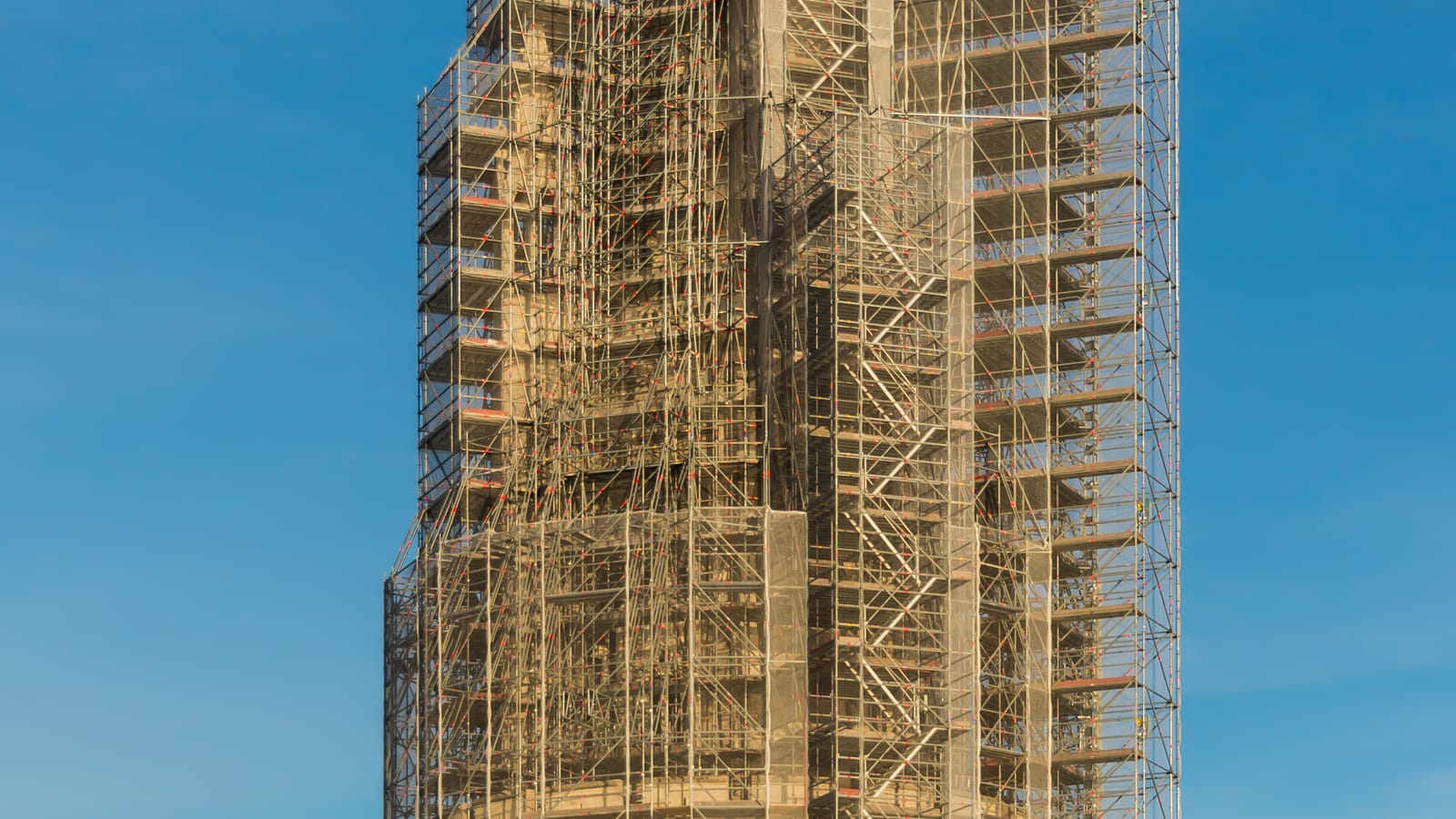
Scaffolding is a temporary structure on which workers and materials stand to reach high places during construction, maintenance and restoration of buildings, bridges and other structures. It is not a motorised machine and has neither an hour meter nor an odometer, but a set of components that are erected, dismantled and counted, so it is managed by the number of pieces, their condition and where they are erected, not by operating life. For that reason the responsibility for managing it falls on the contractor and the supplier together: the first uses it and the second counts its pieces and guarantees that they are compatible. One practical rule is that a scaffold left standing after work has finished is not used again before a fresh inspection. In the Saudi market it is called “saqqala” with no distinction between types, and the metal or the system is then added, as in “saqqala hadid” (steel scaffolding), “saqqala aluminium” and “saqqala mutaharrika” (mobile scaffolding).
Uses
- Plastering, painting and cladding work on building façades.
- Restoring and maintaining façades, bridges and existing structures.
- Building concrete and steel frames on projects.
- Platforms for interior work such as fitting false ceilings and electrical and air-conditioning work.
- Industrial maintenance in factories, tanks and stations.
- Temporary support for formwork and loads in a modified form.
- Temporary stands, platforms and towers at events.
02Classes and sizes
The reference lists six main types: tube and clamp, modular prefabricated systems, frame systems for façades, suspended, timber, and bamboo in some countries. Scaffolding is not rated by a single load but by the design load of its platforms according to the service classification in the system’s bulletin.
| Class | Description | Typical use |
|---|---|---|
| Tube and clamp | Steel tubes joined with adjustable clamps | Complex façades and irregular shapes. |
| Modular system | Prefabricated pieces erected with quick connections | Repetitive building work where erection speed matters. |
| Frame | Ready-made prefabricated frames for façades | Regular building façades. |
| Suspended | A platform hung by ropes from the top of the building | Washing and maintaining façades on towers. |
| Mobile | A tower on wheels with brakes | Light interior and mobile work. |
| Aluminium | The same systems in a lighter metal | Work where moving and erecting recur. |
03Main components
- 01The adjustable base or the load-bearing plate.
- 02The standard (vertical upright) with its joints.
- 03The horizontal longitudinal ledger.
- 04The transverse transom that carries the boards.
- 05The diagonal and cross braces.
- 06The platform boards, of timber or metal.
- 07The clamps and connecting pieces.
- 08The ties that fix the scaffold to the building.
- 09The ladders, access units and side guardrails.
- 10The wheels and brakes of the mobile tower.
04Periodic maintenance schedule
Scaffolding has neither an hour meter nor an odometer, so care is built on events and dates, and the manual of the system supplier sets the intervals and tasks that apply.
| Interval | Typical tasks |
|---|---|
| Before every shift |
|
| After any event that affects its safety |
|
| At every erection, modification or dismantling |
|
| On receipt from the supplier or return to it |
|
| Monthly in the warehouse |
|
| Annually |
|
The manufacturer’s manual governs. The actual intervals and tasks are set by the operation and maintenance manual for your machine’s model, and they are shortened in heavy dust, high heat and continuous operation. This table shows the general order only and does not replace the manual.
05Daily pre-start checklist
12 items
The working rule in the American reference is that a competent person inspects the scaffold and its components before every shift for visible defects.
06Common operating mistakes that cause breakdowns
- Erecting on soft or sloping ground without base plates or spreader boards.
- Exceeding the design load by stacking materials on one platform.
- Mixing pieces from different systems or suppliers whose connections do not match.
- Omitting the ties to the building to save time.
- Leaving openings in the platform or removing guardrails temporarily and then forgetting them.
- Moving the mobile tower with workers on it, or carrying materials on it while it moves.
- Using bent or corroded pieces or pieces with damaged threads.
- Erecting or dismantling by untrained hands and without a competent supervisor.
07Regulatory requirements
Regulatory procedures to check when owning or operating this machine in the Kingdom.
08What to weigh when renting or buying
- The system type and the compatibility of its pieces with what you already have, to avoid mixing systems.
- The condition of the tubes, threads and welds: no bending, deep rust or cracks.
- Counting the pieces by number and type before receipt and on return.
- The erection height and the design load for the platform classification.
- The boards: their material, their soundness and the type of side protection.
- Who erects, who inspects, and who bears loss and damage during the rental.
- The rental period, with the transport, erection and dismantling terms detailed in the contract with no ambiguity.
- The conformity certificates or data supplied by the supplier for the system, if any.
- When buying used: the register of rejected pieces and the number of previous cycles, if available.
Settle these factors first, then enter your own numbers in the Own vs rent calculator or the Equipment operating cost per hour calculator.
09Frequently asked questions
The Saudi term is “saqqala”. The English name is in the name field above, and it corresponds to the same word in classical Arabic.
Tube and clamp, modular system, frame, suspended, timber, and bamboo in some countries.
Aluminium is lighter to move and erect, and steel is usually more suitable for heavier loads, and the judgement rests on the system’s bulletin and load classification, not on the metal alone.
A tower with wheels and brakes for light mobile work; the brakes must be locked and the stabilisers lowered before climbing, and it must not be moved with workers on it.
The foundation, levelness, ties, guardrails, boards and means of access, as in the list above, by a competent person before every shift.
The American reference requires a scaffold to support its own weight and four times the maximum intended load, and the design load for each platform remains in the system’s bulletin, which is the load that must not be exceeded.
By registering each set as an asset with its number of pieces, erection location and date of receipt and inspection, and then matching the count on return.