- Names used in Saudi Arabia
- Rock crusherCrusherCrushing plantMobile crusherKassara (Saudi term)
- Formal name
- كسارة صخور
- English name
- Crusher
- Family
- Heavy equipment · Crushing & screening
- Measured by
- Operating hours
01Definition and uses
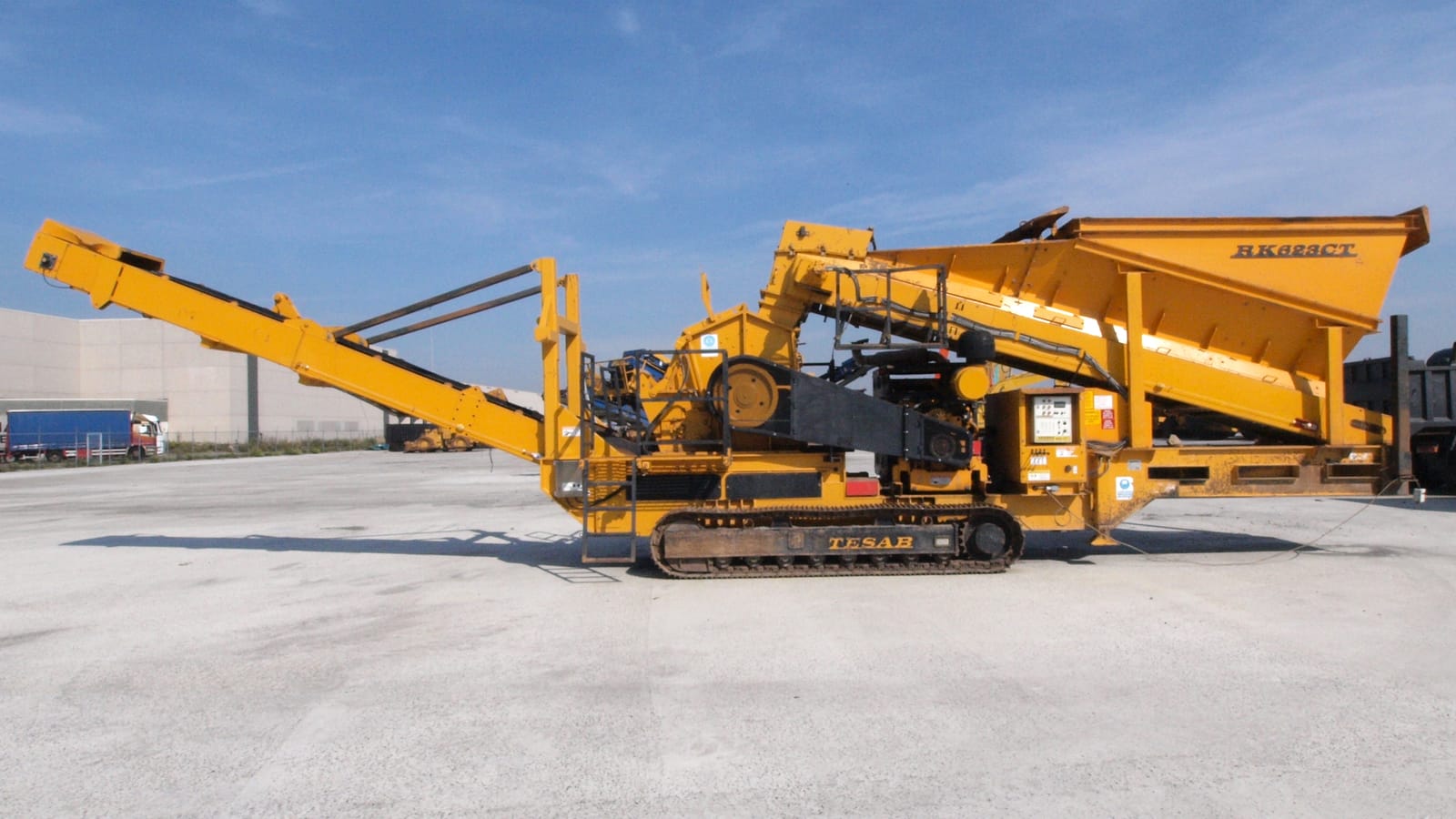
The crusher is a machine that reduces large rocks to smaller rocks, gravel, sand or rock dust. It is placed between two hard surfaces that approach each other and generate energy inside the rock that breaks it. In practice it divides into fixed crushers installed at a quarry or a plant, and mobile crushers on tracks or wheels that move with the work. It is measured in operating hours. A screen that sorts its output is usually attached to it, and that is a separate class in the system’s equipment type list.
Uses
- Crushing quarry rock into aggregate for concrete, asphalt and fill.
- Feeding mining lines with ore before grinding.
- Working at the mine face with loading machines using a mobile crusher.
- Crushing rock on the road and mixing the output directly with asphalt or concrete.
- Recycling demolition waste and concrete into aggregate.
- Preparing material for the foundation layers of roads and structures.
- Producing crushed sand for block factories and ready-mixed concrete.
02Classes and sizes
Crushers are classified by crushing stage: primary and secondary for coarse materials, and tertiary and quaternary to reach fine particles, and each crusher has a largest feed size it does not exceed. They are also classified by type and by place of work. The references mention small mobile crushers that move from site to site, and large mobile ones that crush rock down from a size of about one and a half metres.
| Class | Description | Typical use |
|---|---|---|
| Jaw crusher | A fixed jaw and a moving jaw press the rock between them | Primary crushing in mines and quarries and in recycling. |
| Gyratory crusher | A head cone that gyrates centrally inside a concave body | Primary crushing in large mines. |
| Cone crusher | Similar to the gyratory with a chamber of lesser slope, and rock pressed between a cone and a bowl | Secondary and tertiary crushing. |
| Horizontal and vertical shaft impact crusher | Crushes by impact and not by pressure | Aggregate, recycling and materials needed in a cubical shape. |
| Mobile crusher | A unit on tracks or wheels | Moving quarries and scattered projects. |
| Fixed plant | A crusher, screen and conveyor line on foundations | Quarries and continuous production plants. |
03Main components
- 01The hopper and the feed platform.
- 02The feeder: a pan feeder, a belt or a vibrating grid that regulates the rock entering.
- 03The crushing chamber: the two jaws, or the cone and the bowl, depending on the type.
- 04The replaceable wear liners made of manganese steel.
- 05The eccentric shaft, the flywheel and the bearings.
- 06The discharge opening setting system and overload protection, including the hydraulic system that protects the cone crusher from uncrushable objects.
- 07An electric or diesel motor with drive belts.
- 08The conveyor belts and the sorting screens.
- 09The water sprayers to suppress dust.
- 10The control panel and the emergency switches, and the track or wheels on the mobile type.
04Periodic maintenance schedule
The usual ladder, and the model manual sets the intervals and tasks that apply; the intervals are shorter with abrasive rock and heavy dust.
| Interval | Typical tasks |
|---|---|
| Every 10 hours / daily |
|
| Every 50 hours / weekly |
|
| Every 250 hours |
|
| Every 500 hours |
|
| Every 1000 hours |
|
| Every 2000 hours |
|
The manufacturer’s manual governs. The actual intervals and tasks are set by the operation and maintenance manual for your machine’s model, and they are shortened in heavy dust, high heat and continuous operation. This table shows the general order only and does not replace the manual.
05Daily pre-start checklist
14 items
06Common operating mistakes that cause breakdowns
- Feeding the crusher with rocks larger than the size set for its opening; it is better to break the large ones with a hydraulic breaker near the crusher.
- Uneven or excessive feeding that blocks the chamber.
- Uncrushable metal objects entering the chamber, which the hydraulic system in the cone crusher limits.
- Delaying the replacement of the liners until the frame is damaged.
- Running the crusher without water spray, so harmful dust increases.
- Neglecting to grease the bearings or letting them overheat.
- Cleaning or repairing while the machine is turning or not isolated.
- Setting up the mobile unit on soft or sloping ground.
07Regulatory requirements
Regulatory procedures to check when owning or operating this machine in the Kingdom.
08What to weigh when renting or buying
- The largest feed size against the largest piece your machine feeds.
- The crusher type against the type of rock, its hardness, its abrasiveness and the output shape required.
- Mobile or fixed according to how the rock source moves and the number of sites.
- The condition of the liners and how much of them remains.
- The condition of the bearings, the flywheel and the eccentric shaft and the date of greasing.
- The soundness of the hydraulic system and the overload protection.
- The screening system and the belts and the possibility of expansion with a closed circuit.
- The condition of the track and its motor on the mobile unit.
- When renting: the operating hours charged, who provides the feeder, the wheel loader and the screen, and who bears the liners and the transport.
Settle these factors first, then enter your own numbers in the Own vs rent calculator or the Equipment operating cost per hour calculator.
09Frequently asked questions
The Saudi term is “kassara”. The English name is in the name field above.
Jaw, gyratory, cone, and horizontal and vertical shaft impact, each used according to hardness, abrasiveness and the reduction ratio required.
The mobile one on tracks or wheels moves with the rock source and saves hauling it to a fixed crusher, and the fixed one is a plant set up in one place for continuous production.
The crusher mostly delivers its output to a screen that sorts it and directs each size to its next stage.
Tippers, Bokalins and wheel loaders discharge into its hopper, and a feeder regulates the rate at which the rock enters.
By the crusher type, its rotation speed, the discharge opening and the design of its chamber, and it is checked in the model’s bulletin.
By spraying water at the crusher, the discharge points and the belts, by operating the machine according to the manufacturer’s instructions, and with an air-conditioned cab or a remote control room for the operator.
By recording the operating hours of each unit, the dates of liner inspection and turning, a daily pre-start inspection, and a maintenance plan tied to the hours.