- Names used in Saudi Arabia
- Concrete pumpBoom pumpLine pumpTruck-mounted concrete pumpMidakhkhat khirsana (Saudi term)
- Formal name
- مضخة خرسانة
- English name
- Concrete pump
- Family
- Heavy equipment · Concrete
- Measured by
- Hours and kilometres
01Definition and uses
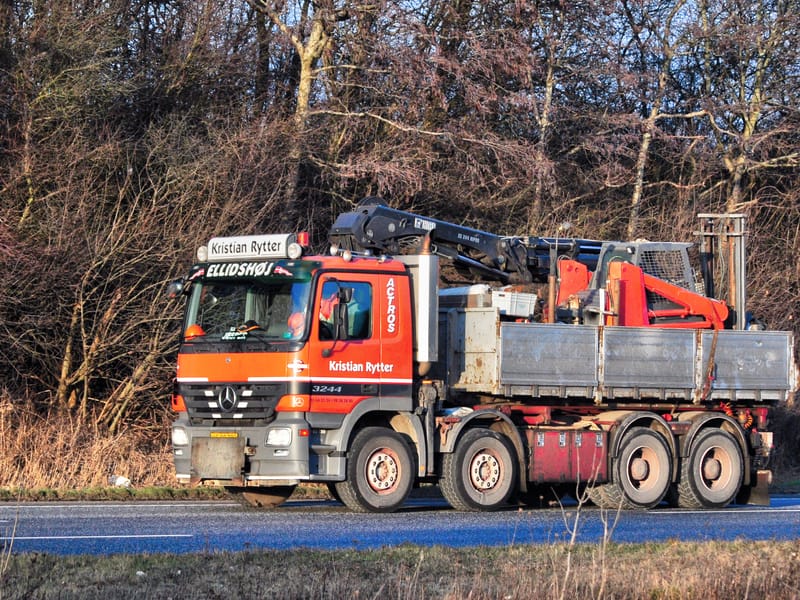
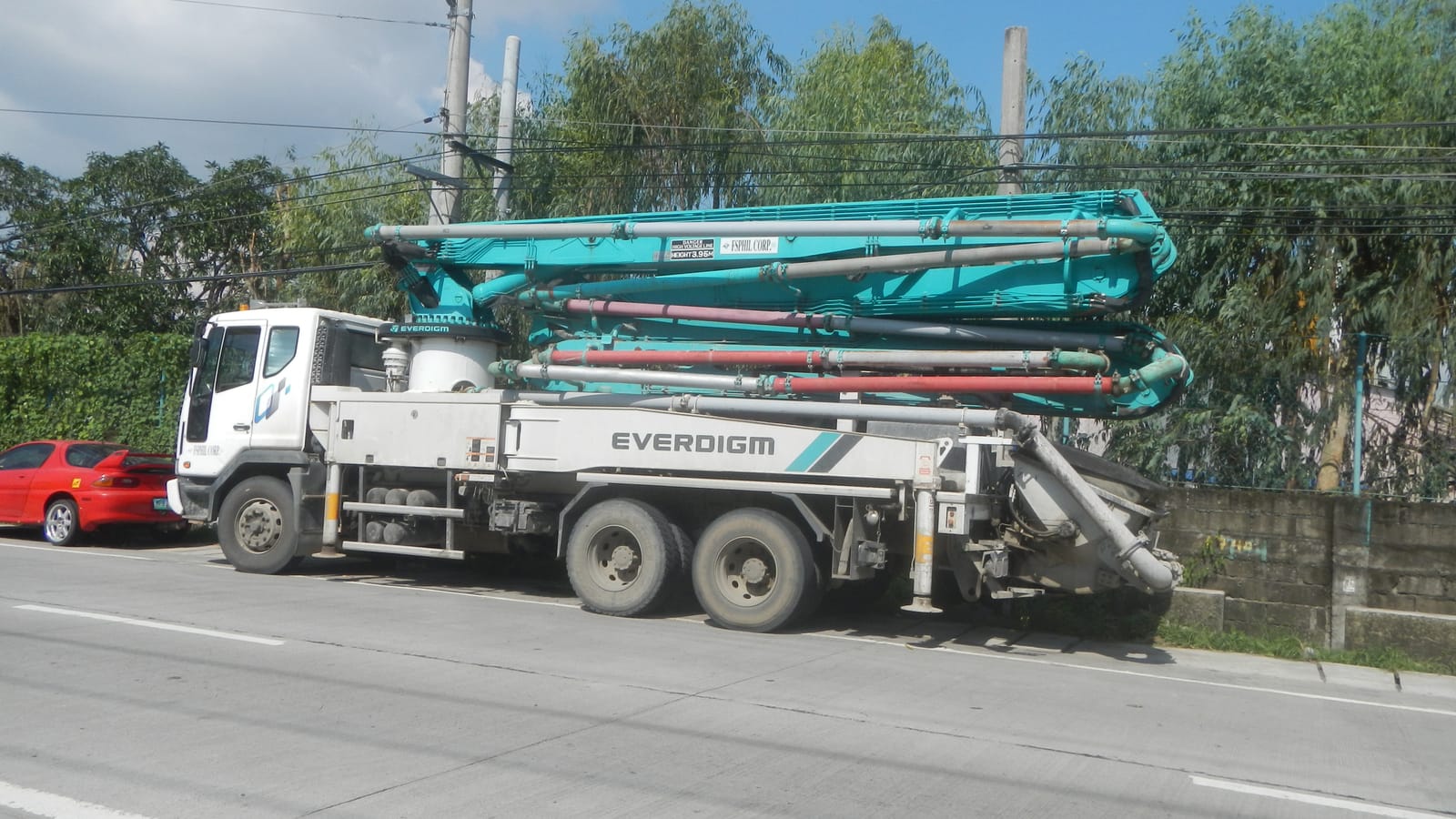
The concrete pump is a machine that moves fluid concrete by pumping from the point where it is received to the pour location. The two best-known types are the boom pump, which is an articulated boom controlled remotely and mounted on a truck or a semi-trailer, and the line pump, to whose outlet pipes or hoses are connected and which is mounted on a truck or a trailer. Two hydraulic pistons drive the concrete, moved by oil pumps run by an electric or diesel motor. It is an asset with a dual meter: for the one mounted on a truck the vehicle is measured in kilometres and the pumping unit in operating hours, and the one mounted on a trailer is measured in hours alone.
Uses
- Pouring ceilings, columns and walls in multi-storey buildings.
- Pouring large footings and rafts with continuous feed from the mixers.
- Reaching pour locations that a mixer cannot enter by extending the boom or pipes.
- Pouring ground slabs, pavements and swimming pools with light line pumps.
- Working in tunnels and mines with pumps mounted on a skid or a rail.
- Pumping mortar and fine-aggregate mixes with the pumps dedicated to them.
- Pouring bridges and extended structures with pipes fixed along the site.
02Classes and sizes
Pumps are classified by the type of mounting, the length of the boom or pipes and the pumping capacity per hour, all of which are in the model’s specification bulletin. The general reference gives pressures of up to 400 bar and a flow of up to 200 cubic metres per hour in piston pumps.
| Class | Description | Typical use |
|---|---|---|
| Boom pump on a truck chassis | An articulated boom controlled remotely and two supporting outriggers | Large buildings and high ceilings. |
| Boom pump on a semi-trailer | The same boom on a trailer pulled by a tractor head | Sites that require a large pump without a truck chassis. |
| Line pump | Pipes or hoses connected to its outlet by hand | Slabs, houses, swimming pools and pavements. |
| Trailer pump | A line pump on a trailer towed by a vehicle | Small and multiple sites. |
| Pump on a skid or rail | Fixed in one place and feeds a long line | Tunnels, mines and special sites. |
03Main components
- 01The chassis, the driver’s cab, the truck engine and the power take-off, on the truck-mounted type.
- 02The hydraulic pumps that move the pumping cylinders.
- 03The two pumping cylinders with their pistons, working in turn on suction and delivery.
- 04The transfer tube that swings in front of the filled cylinder at the end of the stroke.
- 05The hopper, the agitator arms and the guard grid above it.
- 06The articulated boom, its pipes and the end hose, or the pipes and hoses on the line pump.
- 07The two supporting outriggers, their cylinders and the support pads.
- 08The remote control unit and the emergency stop switches.
- 09The washout system: the water tank, its pump and the cleaning balls.
- 10The wear plate and the cutting ring between the hopper and the cylinders.
04Periodic maintenance schedule
The truck-mounted pump is an asset with two schedules: one for the vehicle in kilometres and one for the pumping unit in hours. The following ladder is the usual one, and the model manual sets the intervals and tasks that apply.
The truck vehicle, in kilometres:
| Interval | Typical tasks |
|---|---|
| Daily before moving |
|
| Weekly |
|
| Every 10,000 km |
|
| Every 40,000 km |
|
| Every 80,000 km or annually |
|
The pumping unit, in hours:
| Interval | Typical tasks |
|---|---|
| Every 10 hours / daily | Hydraulic oil level, the water in the water box, washing after the pour, greasing the boom points. |
| Every 50 hours | Check the wear plate and cutting ring, check the hoses and connections, check the two supporting outriggers. |
| Every 250 hours | Hydraulic oil filters according to the manual, check the seals in the pumping cylinders. |
| Every 500 hours | Replace the wear plate and cutting ring when they reach the wear limit, analyse an oil sample. |
| Every 1000 hours | Change the hydraulic oil according to the analysis, check the thickness of the boom pipes. |
| Every 2000 hours | A structural inspection of the boom, its welds and joints, and repair the cylinders if needed. |
The manufacturer’s manual governs. The actual intervals and tasks are set by the operation and maintenance manual for your machine’s model, and they are shortened in heavy dust, high heat and continuous operation. This table shows the general order only and does not replace the manual.
05Daily pre-start checklist
14 items
06Common operating mistakes that cause breakdowns
- Extending the outriggers on soft ground or the edge of an excavation without support pads.
- Extending the boom near an overhead power line.
- Pumping with the hopper nearly empty, so air enters the pipe.
- Adding water to the concrete to ease pumping, so the mix separates and the pipes block.
- Leaving concrete in the pipes for longer than its setting time with no pumping or washing.
- Using worn pipes, which burst under pressure.
- Letting the end hose whip loose or be held by an untrained person.
- Moving the boom quickly with the hopper full.
07Regulatory requirements
Regulatory procedures to check when owning or operating this machine in the Kingdom.
08What to weigh when renting or buying
- The boom or pipe length against the height of the pour and its horizontal distance.
- A pump type suited to the aggregate size: boom or line.
- The pumping unit hours kept separate from the chassis kilometres in the maintenance record.
- The condition of the wear plate, the cutting ring and the two pumping cylinders.
- The soundness of the boom, its welds and joints, and the date of the last structural inspection.
- The condition of the two outriggers and their cylinders and leaks.
- When renting: who bears the supporting mixers, the connecting pipes, the operator and the washing, and how waiting hours are charged.
- The availability of spare parts and maintenance at the dealer in the cities of work.
Settle these factors first, then enter your own numbers in the Own vs rent calculator or the Equipment operating cost per hour calculator.
09Frequently asked questions
The Saudi term is “midakhkhat khirsana”. The English name is in the name field above.
The boom pump is an articulated boom controlled remotely that covers a wide area quickly with less labour, and the line pump needs its pipes and hoses to be connected by hand and suits smaller and closer jobs.
No; the mixer carries the concrete from the plant to the site and mixes it on the way, and the pump pushes it from the discharge point to the pour location, and the two mostly work together.
The pump boom is a placing boom that carries concrete pipes and carries no load suspended from a hook, so it is not a crane.
With a record for each pump that separates the chassis kilometres from the pumping unit hours, a daily inspection before the pour, a maintenance plan tied to the two meters, and tracking the hours of use for each site.
Because concrete hardens if it is not kept moving, because a mix made fluid by extra water separates, and because dirty or worn pipes narrow the passage.
The ground under the two outriggers, the clearance from electricity, the hydraulic oil, the wear plate, the pipes and their supports and the remote control, as in the list above.