- Names used in Saudi Arabia
- Tower craneHammerhead tower craneConstruction tower craneTower crane (Saudi term)Kiran tawirRafi‘a burjiyya
- Formal name
- رافعة برجية
- English name
- Tower crane
- Family
- Heavy equipment · Cranes
- Measured by
- Operating hours
01Definition and uses
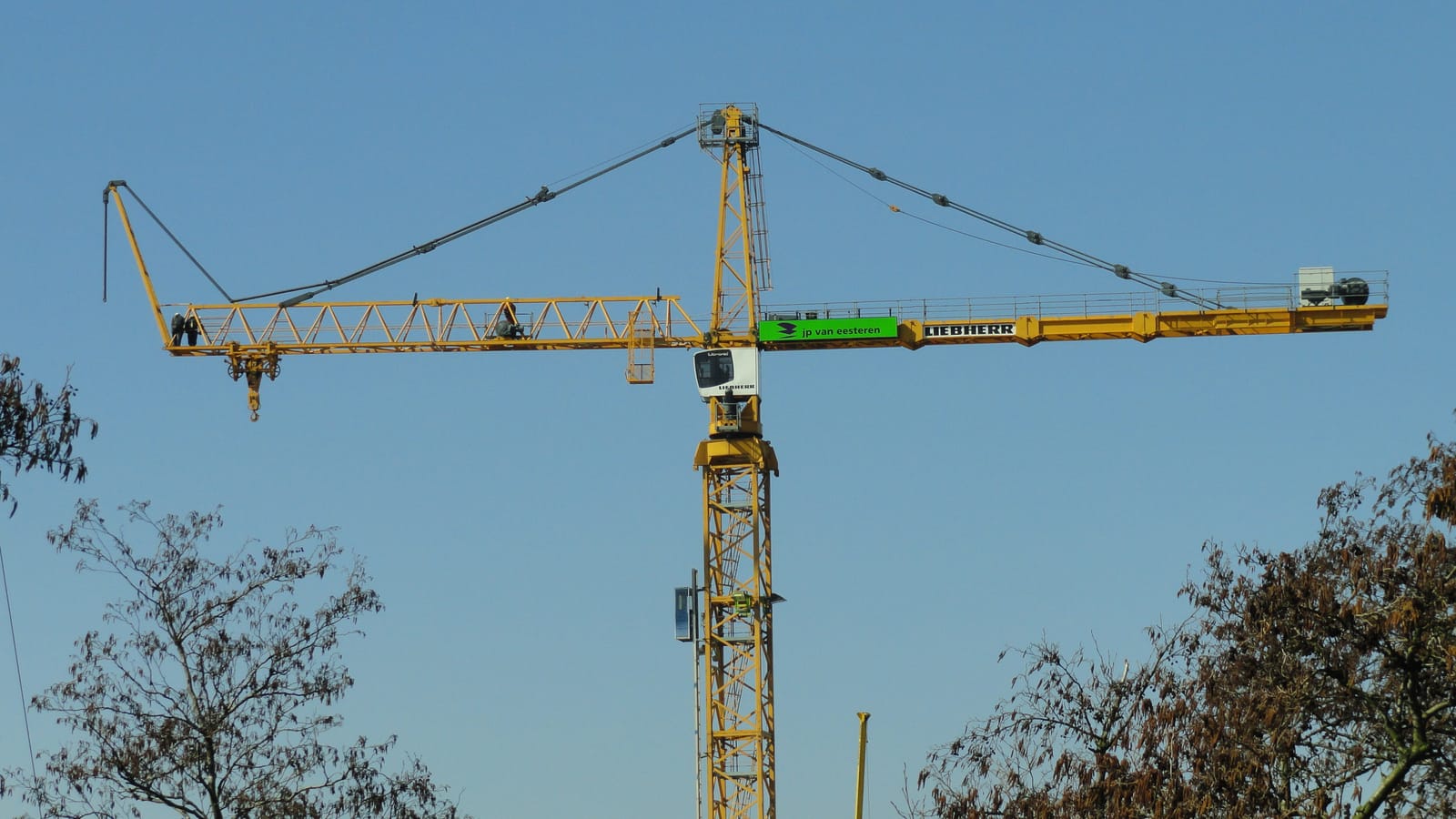
The tower crane is a crane fixed on a concrete base, sometimes tied to the sides of the structure, that combines the best height and lifting capacity, and it is used in building towers and tall structures. On the base stands a lattice tower carrying the slewing unit, above which are a long horizontal jib and a shorter counter-jib that carries the counterweights and the operator’s cab. The hook height may exceed one hundred metres. Each model has a load chart that sets what it lifts at each radius, so it lifts a larger load near the centre of rotation and a smaller one at maximum reach. It is measured in operating hours, and it is a site machine that does not run on roads, erected on the project and dismantled when it ends. In the market “tower crane”, “kiran tawir” and “rafi‘a burjiyya” are said for one machine.
Uses
- Lifting reinforcing steel, formwork and concrete in skips in building towers.
- Handling precast elements on large projects.
- Lifting materials to the upper floors of residential and commercial buildings.
- Building factories, power stations and large infrastructure projects.
- Serving tight sites that cannot take a large mobile crane.
- Handling heavy parts in industrial work.
- Building wind turbine towers with the climbing type.
02Classes and sizes
Tower cranes are classified by jib type, erection method and stability, and the capacity, radius and height are set by the load chart and the model plate.
| Class | Description | Typical use |
|---|---|---|
| Fixed jib with trolley | A horizontal jib on which a trolley carrying the hook runs | The most common on building sites. |
| Luffing jib | A jib that rises and falls at an angle | Tight sites next to existing buildings. |
| Self-erecting | Transported in one piece and erected by a qualified technician without a larger crane, with a smaller capacity | Small and medium projects. |
| Climbing | Raises itself in stages as the building rises | Skyscrapers and wind turbines. |
| Rail-mounted | Its base runs on a rail | Long sites that need horizontal movement. |
03Main components
- 01The lattice tower made of steel sections assembled during erection.
- 02The slewing unit at the top of the tower.
- 03The operator cab, which holds the controls, the load moment indicator and the anemometer.
- 04The horizontal jib and the trolley running on it, or the luffing jib.
- 05The counter-jib with the counterweights and the hoist motor and its drum.
- 06The hoist winch: a motor, gearbox, drum, wire rope and brake.
- 07The hook and the hook block.
- 08The base and the concrete foundation or the fixing frame.
- 09The limit switches and the devices for load limiting and collision avoidance.
- 10The electrical system and the control boxes.
04Periodic maintenance schedule
The usual ladder, and the manufacturer’s manual for the model is the reference that applies for intervals and tasks. The American crane regulation provides for a visual inspection before every shift by a competent person, a monthly inspection, and a full annual inspection by a qualified person that may require dismantling.
| Interval | Typical tasks |
|---|---|
| Every 10 hours / daily |
|
| Every 50 hours / weekly |
|
| Every 250 hours |
|
| Every 500 hours |
|
| Every 1000 hours |
|
| Every 2000 hours |
|
The crane is inspected after every erection, modification or repair of a critical part by a qualified person before it is used, and after it has been out of use for three months or more.
The manufacturer’s manual governs. The actual intervals and tasks are set by the operation and maintenance manual for your machine’s model, and they are shortened in heavy dust, high heat and continuous operation. This table shows the general order only and does not replace the manual.
05Daily pre-start checklist
15 items
The crane regulation lists the inspection items before every shift, among them the control mechanisms, the drive mechanisms, the pressurised hoses, the hooks, the rope reeving, the wire rope, the electrical equipment, the supporting ground and the safety devices.
06Common operating mistakes that cause breakdowns
- Lifting a load above what the load chart allows at the radius used.
- Operating in wind above what the manufacturer permits without adjusting the work to the wind.
- Leaving the controls with the load suspended, which is forbidden except under defined controls.
- Disabling a limit switch or the load moment indicator to speed up work.
- Pulling the load sideways instead of lifting it vertically.
- Slewing or braking suddenly, so the load swings and strains the jib and the tower.
- Operating near power lines or another crane without a collision avoidance system or coordination.
- Neglecting to check the base bolts and tower sections or postponing the wire rope inspection.
07Regulatory requirements
Regulatory procedures to check when owning or operating this machine in the Kingdom.
08What to weigh when renting or buying
- Studying the site first: the building height, the radius required and the loads, then choosing the model from the load chart.
- Designing the concrete foundation and tying the crane to the structure, and who bears its design and execution.
- Who erects and dismantles, since erection is run by a competent and qualified person.
- The licensed operator, the signaller and the qualified rigger, and whether the contract includes them.
- The presence of a collision avoidance system if the site is beside cranes or buildings.
- A recent inspection certificate, a maintenance record and operating hours, and the condition of the ropes and sections.
- The accompanying lifting accessories: a hook, a concrete skip and slings.
- When renting: the contract duration, and the stoppage of the crane due to wind and who bears the financial cost of it.
Settle these factors first, then enter your own numbers in the Own vs rent calculator or the Equipment operating cost per hour calculator.
09Frequently asked questions
A tower crane fixed on a foundation that combines height and lifting capacity, and it is used in building tall structures.
The tower crane is fixed on a foundation throughout the project and reaches great heights, while the mobile crane is on a moving structure with wheels or tracks and moves between sites.
The fixed jib with trolley, the luffing jib, the self-erecting and the climbing; there are also models whose base runs on a rail.
It is mostly erected with a larger mobile crane, and the erection and dismantling are run by a competent and qualified person; the self-erecting type is transported in one piece and erected by a qualified technician.
An inspection after erection, before every shift, monthly, and a full annual one dismantling what is necessary, then after any repair or modification.
The American regulation requires the operator to be trained, certified and assessed before operating.
The foundation, the erection, the operator, the signaller, the inspection certificate and the collision avoidance system, as in the section above.