- Names used in Saudi Arabia
- Asphalt paverPaving machineRoad paverBlacktop paverFarrada asfalt (Saudi term)Farrada
- Formal name
- فرّادة الأسفلت
- English name
- Asphalt paver
- Family
- Heavy equipment · Roads & compaction
- Measured by
- Operating hours
01Definition and uses
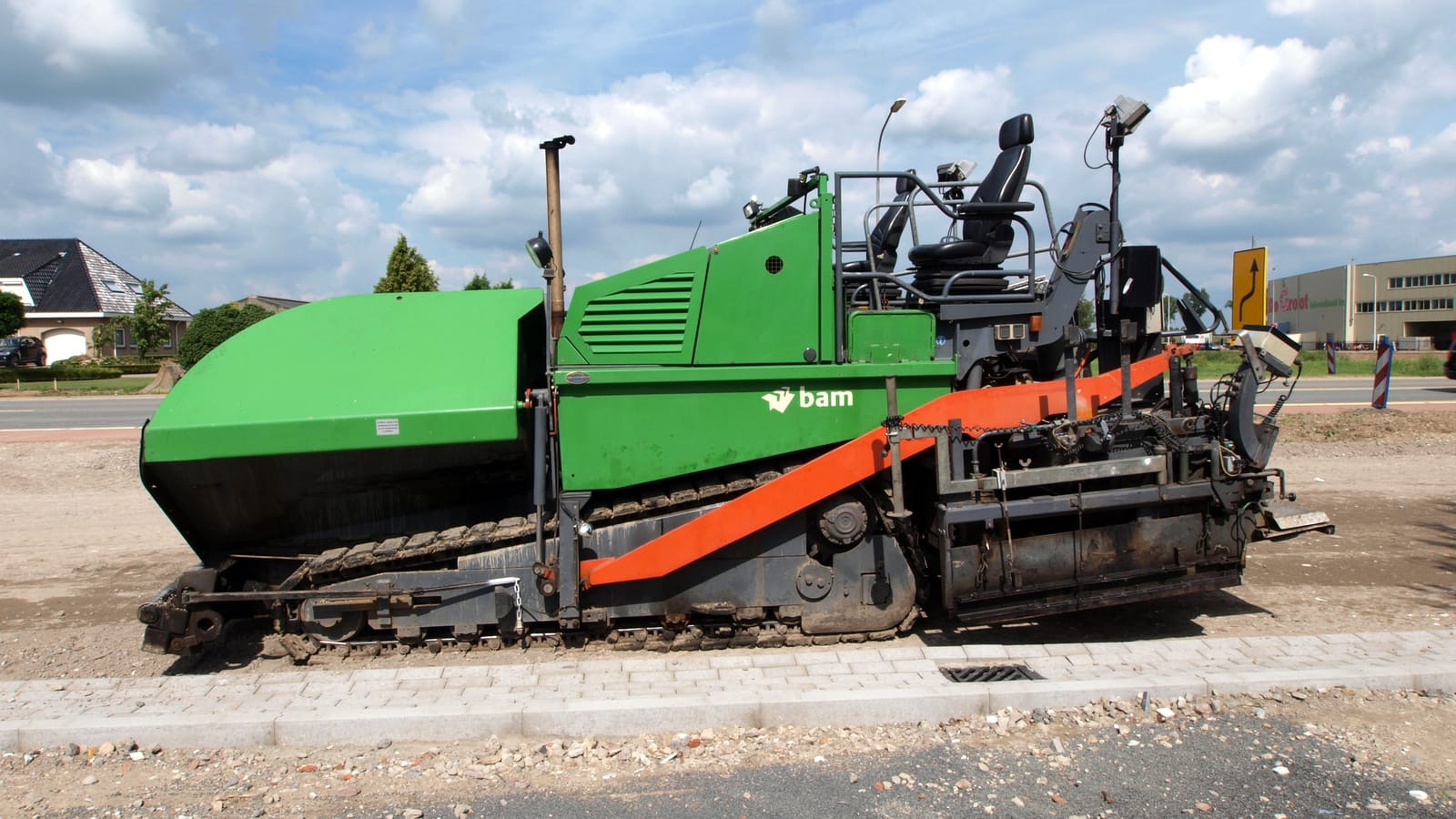
The paver is a construction machine that lays asphalt concrete or cement concrete on roads, bridges, car parks and the like, laying it level and compacting it lightly. A roller usually follows it to complete the final compaction. The asphalt enters it from the hopper, a conveyor carries it to the auger that spreads it in front of the screed, and the screed spreads it across the width of the road. The modern paver goes back to a machine developed by Barber-Greene, which obtained its patent in 1938 after the mixing process was separated from the laying process. It is measured in operating hours. It is not the road roller, since the paver lays and the roller compacts.
Uses
- Laying asphalt layers on new roads and renewing old layers.
- Paving bridges, car parks and yards.
- Laying aggregate base courses under the asphalt.
- Paving highways with cement concrete using a slipform paver.
- Paving pavements and small paths with a small paver.
- Levelling the layer to a thickness and slope set by the drawings.
- Wide patching work and re-paving after service lines.
02Classes and sizes
Pavers are classified by the type of undercarriage, wheels or tracks, by paving width, and by the material, asphalt or cement. The paving width and the hopper capacity are in the model’s bulletin, and the executing company chooses them according to the road width.
| Class | Description | Typical use |
|---|---|---|
| Wheeled paver | Moves on rubber tyres | Paved roads and work that moves often. |
| Tracked paver | Moves on tracks | Soft ground and large loads. |
| Small paver | A narrow paving width and a smaller engine | Pavements, paths and small car parks. |
| Slipform paver | Lays cement concrete with a screed in a sliding form | Cement highways. |
| Material transfer unit | A machine that feeds the paver with asphalt without contact | Improving surface smoothness through continuous feeding. |
03Main components
- 01The hopper that receives the asphalt from the tipper or the transfer unit.
- 02The slat conveyor from the hopper to the rear.
- 03The auger that spreads the asphalt in front of the screed.
- 04The floating screed, its flat and its two tow arms.
- 05The screed heating system by gas or electricity with the vibrator and the tamper.
- 06The level and slope sensors and the automatic control devices for the screed angle.
- 07The engine, the drive group and the hydraulic system.
- 08The wheels or tracks.
- 09The control panel, the operator platform and the screed assistant platform.
- 10The cab or canopy and the alarm devices.
04Periodic maintenance schedule
The usual ladder, and the model manual sets the intervals and tasks that apply; the intervals are shorter in high heat and with sticky asphalt mixes.
| Interval | Typical tasks |
|---|---|
| Every 10 hours / daily |
|
| Every 50 hours / weekly |
|
| Every 250 hours |
|
| Every 500 hours |
|
| Every 1000 hours |
|
| Every 2000 hours |
|
The manufacturer’s manual governs. The actual intervals and tasks are set by the operation and maintenance manual for your machine’s model, and they are shortened in heavy dust, high heat and continuous operation. This table shows the general order only and does not replace the manual.
05Daily pre-start checklist
14 items
06Common operating mistakes that cause breakdowns
- Changing speed and stopping repeatedly, so the screed rises or falls and waviness appears.
- The tipper bumping the paver or changing its speed while it discharges, which affects the screed height.
- Letting the asphalt stock in front of the screed fall or rise from the constant level, so the layer thickness varies.
- Starting with a cold or unheated screed, so the asphalt sticks and the surface tears.
- Leaving asphalt in the hopper and conveyor at the end of the day without cleaning.
- Working with uncalibrated or dirty sensors.
- Neglecting to tension and grease the chains, so the slats and the auger wear.
- Workers going between the tipper and the paver while moving.
07Regulatory requirements
Regulatory procedures to check when owning or operating this machine in the Kingdom.
08What to weigh when renting or buying
- The basic paving width and its reach with extensions against the road width.
- Wheels or tracks according to the ground and moving.
- The hopper capacity against the capacity of the tippers that feed it.
- The condition of the screed, its plates and the heating system.
- The condition of the conveyor and the auger and their chains.
- The sensor and automatic control system and its calibration.
- The hour-meter reading with the maintenance record.
- The suitability of a material transfer unit for the project that requires high smoothness.
- When renting: how hours are counted and the minimum, who provides the operator and the screed assistant, and who bears the transport and the fuel.
Settle these factors first, then enter your own numbers in the Own vs rent calculator or the Equipment operating cost per hour calculator.
09Frequently asked questions
In the Saudi market it is called “farrada”. The English name is in the name field above, and the machine has several other names.
The paver lays the asphalt and compacts it lightly, and the “rassasa” is a roller that comes after it to compact the layer finally.
The asphalt plant, then the tippers that carry it, then the paver, then the rollers.
It takes the asphalt heaped in front of it, spreads it across the road width and compacts it initially, and it is a floating screed pulled by a long arm to reduce the effect of the ground beneath it.
Mostly from a change in the paver’s speed or the quantity of asphalt in front of the screed, since the screed height follows them.
It feeds the paver with asphalt without contact and keeps a constant speed and regular supply, so the smoothness of the surface improves.
Yes, with a type called a slipform paver, in front of which ready-mixed concrete trucks discharge their loads and which spreads and levels them with its screed.
The oils, the leaks, the cleanliness of the hopper, conveyor and auger, their chains, the screed, the sensors, the brakes and the alarms, as in the list above.