- Names used in Saudi Arabia
- Plate compactorVibratory plateRammerTamping rammerDakkak (Saudi term)
- Formal name
- دكّاكة يدوية
- English name
- Plate compactor / rammer
- Family
- Heavy equipment · Roads & compaction
- Measured by
- No meter
01Definition and uses
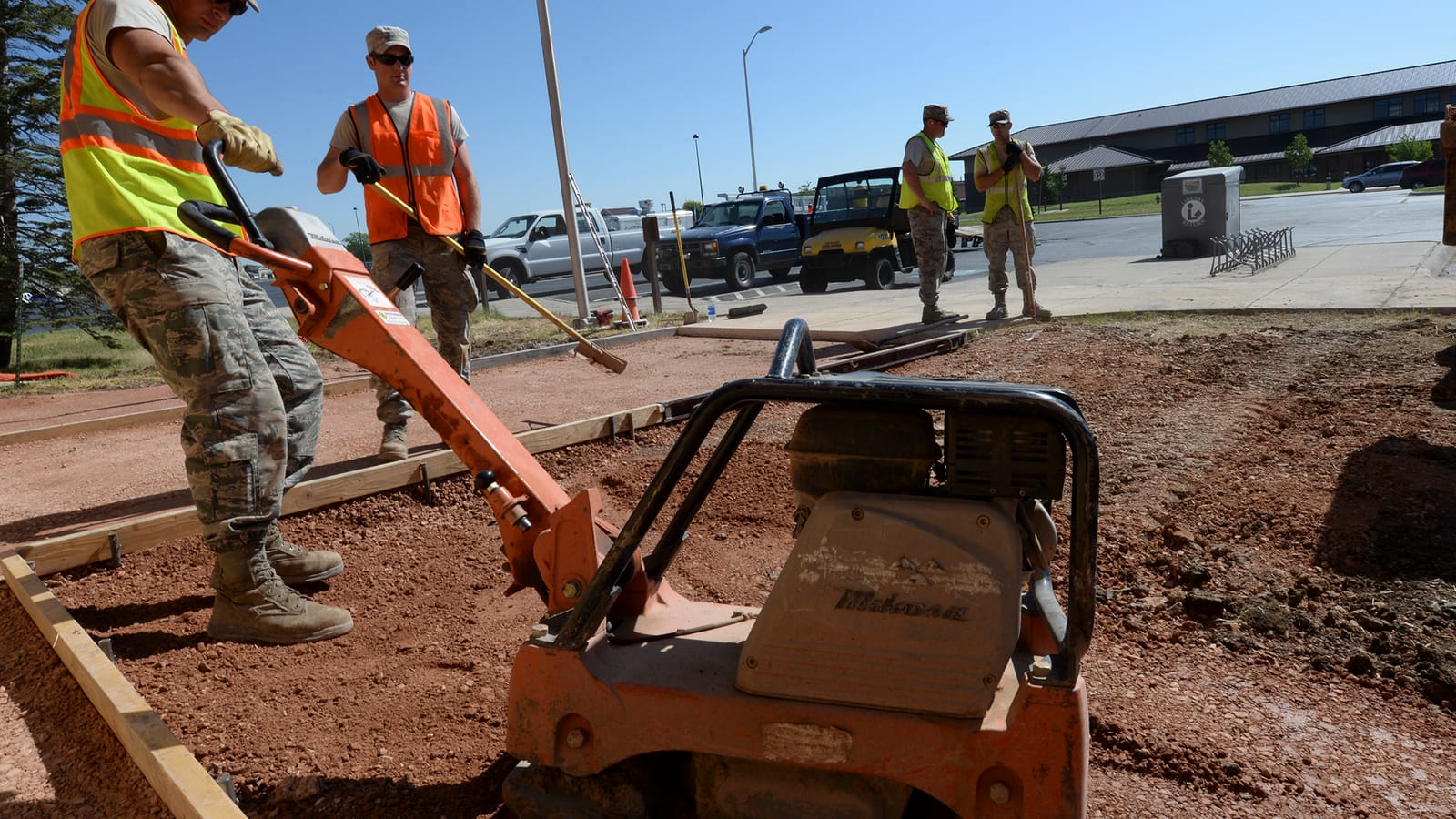
The plate compactor is a small compaction machine that the operator guides by hand. In construction there are three main types of compaction equipment: the plate, the rammer and the roller, and the “dakkak” covers the first two. The vibratory plate has a large vibrating base suited to creating a uniform level, and the rammer has a smaller foot and works to compact narrow trench backfill. Vibration in plates is generated by eccentric weights that rotate quickly. As for the rammer, its foot is mounted on a sliding leg inside which moves a piston pushed by the engine through a reducer, a crank and a connecting rod, and strong springs tie it to the leg. Most of this equipment has no hour meter, so its use is counted from the daily operating record.
Uses
- Compacting the backfill of trenches for water and gas pipes and cables with the rammer.
- Compacting aggregate base courses under floors and pavements.
- Compacting sand and crushed stone under tiles and interlocking pavers.
- Compacting asphalt in patching and pothole repair with a plate fitted with a water tank.
- Compacting soil around foundations and retaining walls.
- Narrow work that a roller cannot enter.
- Stabilising the excavation surface before pouring blinding concrete or paving.
- Successive compaction on small construction sites.
02Classes and sizes
The equipment is classified by type, weight and vibration centrifugal force, and these are in the model’s bulletin. The references state that small plates tend to advance forward because of the vibration, and that some larger ones are fitted with direction control. It is recommended to choose the type according to the depth, the area and the nature of the soil, not by size alone.
| Class | Description | Typical use |
|---|---|---|
| Single-direction plate | A vibrating base that advances forward | Relatively wide surfaces and tiles. |
| Reversible plate | Controls forward and backward | Trenches and larger work. |
| Rammer | A small foot that jumps vertically and leans forward | Backfilling narrow trenches. |
| Plate with a water tank | For compacting asphalt without sticking | Patching and pothole repair. |
| Remote-controlled trench roller | Works by remote control for operator safety | Deep dangerous trenches. |
03Main components
- 01The small petrol or diesel engine.
- 02The lower steel base of the plate.
- 03The vibration unit with the rotating eccentric weights.
- 04The centrifugal clutch, the drive belt and its cover.
- 05The rubber mounts between the engine and the base and the guide handle.
- 06The guide handle, the throttle switch and the stop switch.
- 07On the rammer: the sliding leg, the piston, the springs and the protected bellows of the joint.
- 08The water tank and its filters for the asphalt plate.
- 09The wheel kit and lifting tools for moving the machine.
- 10The air filter and the fuel tank.
04Periodic maintenance schedule
The usual ladder for a small engine, and the model manual sets the intervals and tasks that apply. If the machine has no hour meter, the hours are counted from the daily operating record for each site.
| Interval | Typical tasks |
|---|---|
| Every 10 hours / daily |
|
| Every 50 hours / weekly |
|
| Every 250 hours |
|
| Every 500 hours |
|
| Every 1000 hours |
|
| Every 2000 hours |
|
The manufacturer’s manual governs. The actual intervals and tasks are set by the operation and maintenance manual for your machine’s model, and they are shortened in heavy dust, high heat and continuous operation. This table shows the general order only and does not replace the manual.
05Daily pre-start checklist
14 items
06Common operating mistakes that cause breakdowns
- Compacting a very thick layer in one go, so what is beneath stays uncompacted.
- Compacting on soil soaked with water or very dry.
- Running the plate on hard concrete or a hard surface unnecessarily, which damages the mounts and the base.
- Resisting the machine’s movement instead of letting the vibration lead it, which strains the operator’s hands and arms.
- Leaving cracked rubber mounts without replacement.
- Running a rammer on rocky ground, which breaks the foot.
- Refuelling while the engine is hot or running.
- Neglecting to clean sticking asphalt from the base.
07Regulatory requirements
Regulatory procedures to check when owning or operating this machine in the Kingdom.
08What to weigh when renting or buying
- The type against the work: a plate for surfaces and a rammer for narrow trenches.
- The weight and base width against the area to be compacted.
- Single direction or reversible according to the work.
- The condition of the engine: ease of starting and clear exhaust.
- The condition of the base and the vibration unit and its oil leaks.
- The condition of the rubber mounts and the handle.
- The water tank if the work is on asphalt.
- The availability of common spare parts such as belts and filters.
- When renting: receiving the machine with a clean engine and the oil level checked, and specifying who bears the fuel and any damage caused by misuse.
Settle these factors first, then enter your own numbers in the Own vs rent calculator or the Equipment operating cost per hour calculator.
09Frequently asked questions
The Saudi term is “dakkak”. The English name is in the name field above, and in some countries the plate is called by the name of its famous maker.
Both are compaction equipment. The dakkak is a small machine with a vibrating base or a jumping foot for narrow work, and the rassasa is a roller with one or more drums that compacts wider areas.
The plate is a wide vibrating base suited to creating a uniform level, and the rammer is a small foot that tamps vertically and so suits narrow trenches.
Because its vibration generates a tendency to advance, and in the rammer the foot leans slightly from the vertical so it tends to walk forward.
In compacting asphalt to stop it sticking to the base, and in patching and pothole repair.
A daily check of the oils, the filter and the bolts, then intervals at 250, 500 and 1000 hours, and the model manual sets the tasks.
By registering them as assets with internal numbers, assigning them to projects, recording their hours of use by hand, and inspecting them daily before operation.