- Names used in Saudi Arabia
- Motor graderRoad graderGraderBlade graderGrader (Saudi term)Greder
- Formal name
- ممهّدة طرق
- English name
- Motor grader
- Family
- Heavy equipment · Roads & compaction
- Measured by
- Operating hours
01Definition and uses
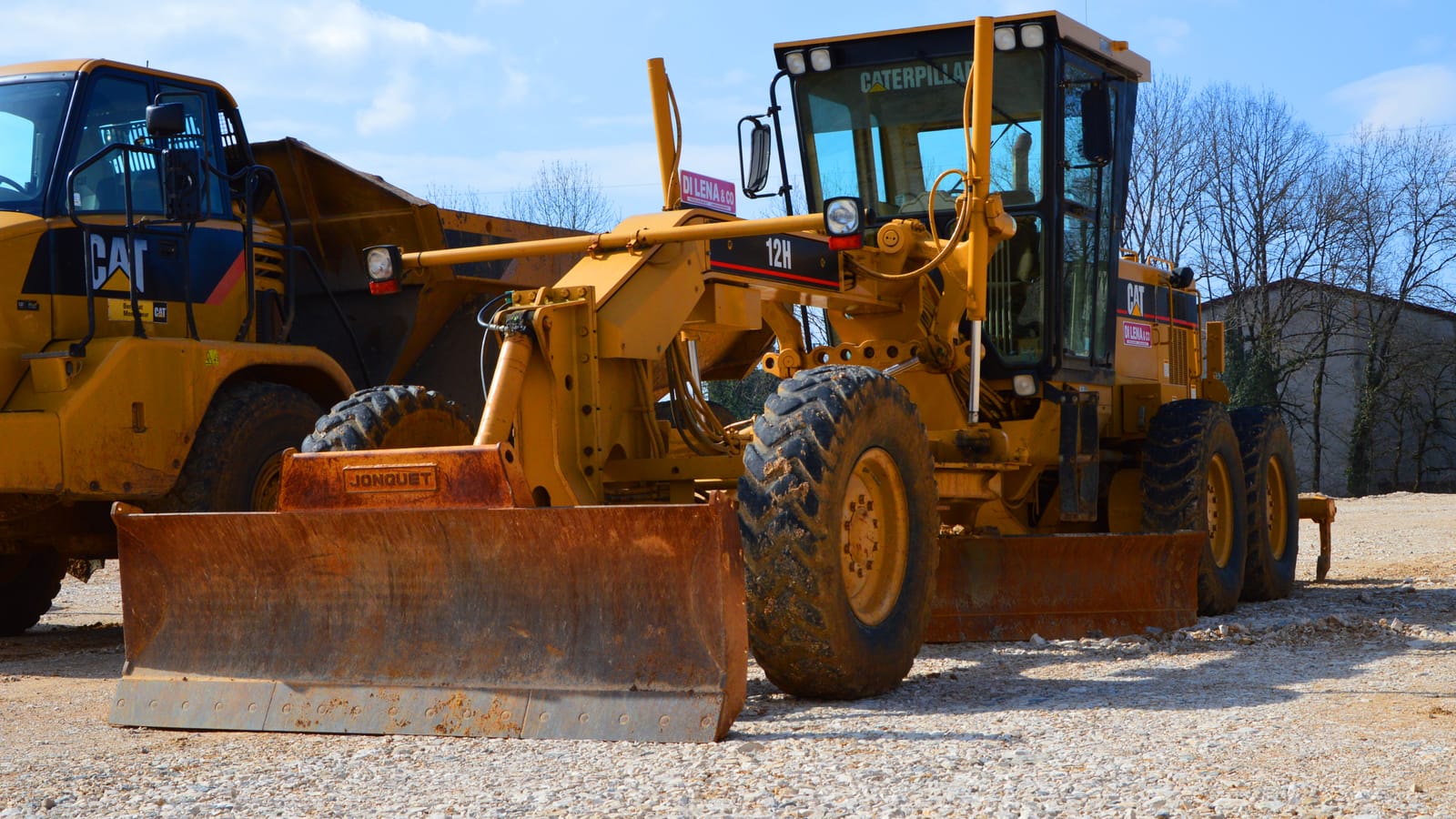
The motor grader is a heavy machine with a long blade used to produce a level surface in grading work; in most modern models it is self-propelled, usually with three axles: the steering wheels at the front, then the blade, then the cab and engine over two successive rear axles. The angle, tilt and height of the blade are set with high precision, so it is used for final grading after other equipment has finished the rough grading. Its life is measured in operating hours, and it is worth noting that the blade type and its control system change the precision of the machine considerably. In the Saudi market “grader” and “greder” are said for the same machine.
Uses
- Grading and maintaining dirt and gravel roads.
- Preparing the level base course on paved roads before the final surface.
- Grading foundation platforms before large buildings are built.
- Shaping sloped surfaces for drainage or for safety.
- Cutting shallow drainage ditches with sloped sides along highways.
- Snow removal in countries where it falls, with special equipment.
- Grading aggregate and fill and mixing the layers together with the water tanker and the roller.
- Opening dirt tracks for projects and maintaining them during execution and in rainy seasons.
02Classes and sizes
According to the reference, grader capacities range from a blade width of two and a half metres to seven and a half metres, and from engines of ninety-five to three hundred and seventy-five kilowatts. The actual class of each model is in the specification sheet.
| Class | Description | Typical use |
|---|---|---|
| Small | A short blade and a smaller engine | Secondary roads and tight sites. |
| Medium | The most widespread class in contracting | Roads and preparing base courses. |
| Large | A wide blade and a powerful engine | Major projects and mine roads. |
| With extra front-wheel drive | Front wheels that drive to improve performance | Soft ground. |
| With digital grade control | Laser and positioning systems that control the blade elevation | Precise grading to a small tolerance. |
03Main components
- 01The blade, its cutting edge and its replaceable end bits.
- 02The circle that turns the blade, the drawbar and the hydraulic motor for rotation.
- 03The front axle and the leaning steering wheels.
- 04The frame articulation joint between front and rear to reduce the turning radius.
- 05The two successive rear axles, and the tandem drive housings that carry the drive to them by chains or gears depending on the model.
- 06The engine, the transmission and the coolers.
- 07The hydraulic valves and the control levers or joystick.
- 08The rear attachments such as the ripper and the scarifier, and the front blade.
- 09The cab and the rollover protective structure.
- 10The digital grade-control devices and their antennas.
04Periodic maintenance schedule
The usual ladder, and the manual for the specific model sets the intervals and tasks that apply; the intervals are shorter when working in heavy dust.
| Interval | Typical tasks |
|---|---|
| Every 10 hours / daily |
|
| Every 50 hours / weekly |
|
| Every 250 hours |
|
| Every 500 hours |
|
| Every 1000 hours |
|
| Every 2000 hours |
|
The manufacturer’s manual governs. The actual intervals and tasks are set by the operation and maintenance manual for your machine’s model, and they are shortened in heavy dust, high heat and continuous operation. This table shows the general order only and does not replace the manual.
05Daily pre-start checklist
13 items
The earthmoving equipment rules in the reference explicitly cover the grader, and require seat belts, brakes, a protective structure, a horn and a reverse alarm.
06Common operating mistakes that cause breakdowns
- Grading with the blade digging into hard ground instead of cutting in stages, so the machine vibrates and the circle is damaged.
- Dropping the blade onto the ground with force or travelling with it raised over uneven ground.
- Travelling at high speed with the blade angled, which strains the axles and tyres.
- Neglecting the cutting edge until the main body of the blade wears.
- Leaving the circle ungreased in heavy dust.
- Neglecting low tyre pressure or travelling on mismatched tyres.
- Manoeuvring at a sharp articulation angle in the joint on soft ground.
- Stopping a hot engine immediately without a short cool-down for the turbocharger.
07Regulatory requirements
Regulatory procedures to check when owning or operating this machine in the Kingdom.
08What to weigh when renting or buying
- The blade width and the engine power against the type of work.
- The circle clearance, the condition of its teeth and the blade cylinders.
- The condition of the cutting edge and the end bits and how much of them remains.
- The condition of the front joint, the steering wheels and the clearance in the lean axles.
- Hydraulic leaks and the transmission performance in all speeds.
- The condition of the six tyres and the successive rear axles.
- The presence of the digital grade-control system and its soundness if required.
- The hour-meter reading with the maintenance record, and the availability of spare parts for the brand in the area.
- When renting: how hours are counted and the daily minimum, and who bears the fuel, the operator, the tyres and the transport of the machine.
Settle these factors first, then enter your own numbers in the Own vs rent calculator or the Equipment operating cost per hour calculator.
09Frequently asked questions
In the Saudi market it is called “grader” or “greder”. The English name is in the name field above, and it is also called a road grader or a blade.
By size: small, medium and large; by equipment: with front-wheel drive, with rear attachments, and with digital grade control.
Final grading of surfaces, preparing the base course and shaping slopes and drainage ditches.
The grader is a precise grading machine with wheels and a blade that can tilt and rotate, while the bulldozer is a tracked machine for pushing masses and removing rough layers.
They are the manufacturer’s code for the class and the model generation, and their meaning is in the manufacturer’s bulletin and the operator’s handbook, not in a general rule.
When its wear reaches the limit set by the manufacturer, before the main body of the blade wears.
In operating hours, since it is a site machine and not a road vehicle.