- Names used in Saudi Arabia
- Backhoe loaderBackhoeDigger loaderJCB (Saudi term)Back hoeHafar loader
- Formal name
- حفّارة تحميل خلفية
- English name
- Backhoe loader
- Family
- Heavy equipment · Digging & loading
- Measured by
- Operating hours
01Definition and uses
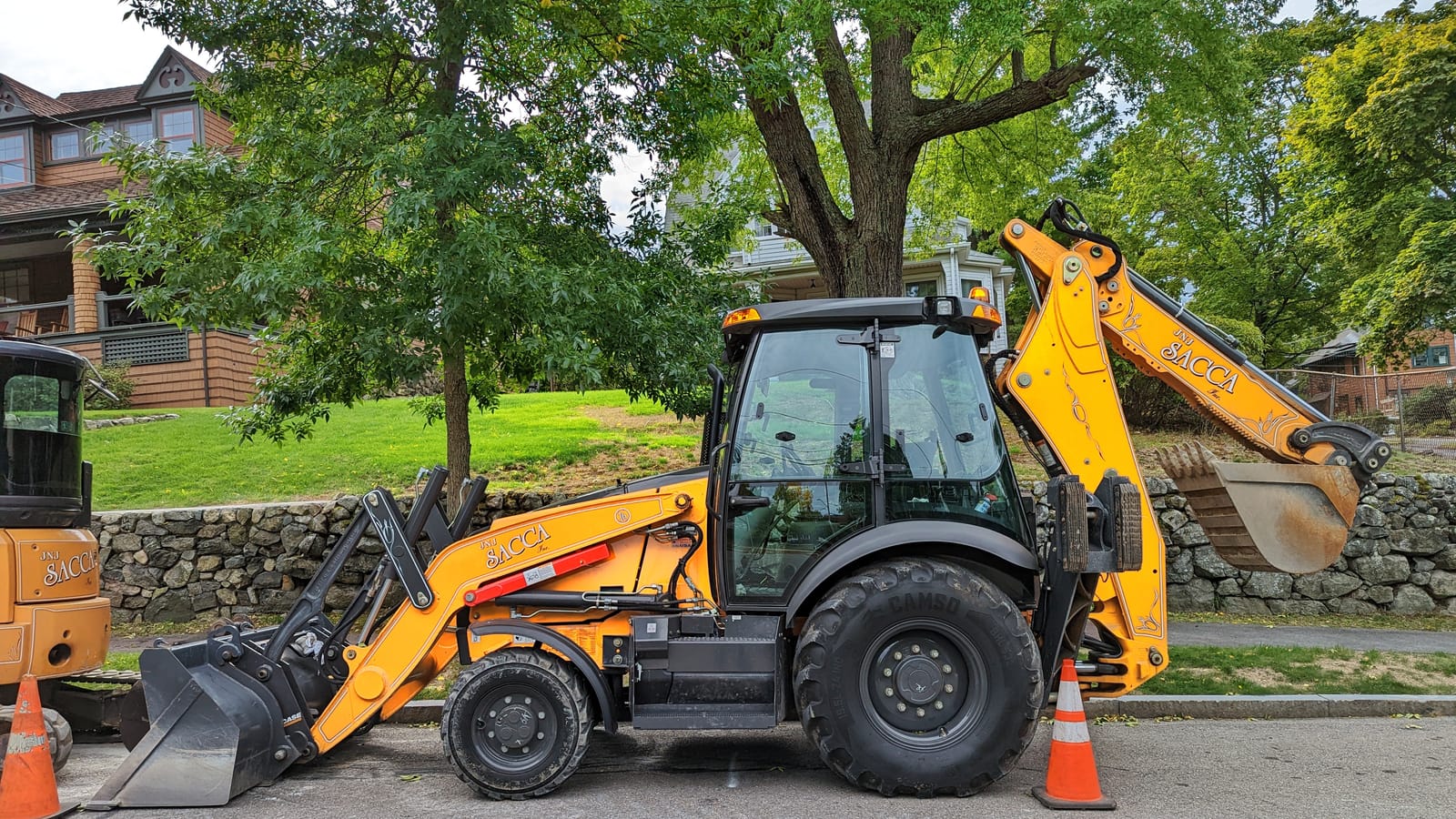
The backhoe loader is a wheeled machine that combines two functions: a front loading bucket like the wheel loader, and a rear digging arm with an articulated bucket like the excavator, with an operator seat between them that rotates between the two directions. In the Saudi market the machine is called by the name of the British company that made it famous, “JCB”, whoever its manufacturer is, and the company itself states that it invented this machine in 1953 and that about half of those sold worldwide are its own production. Its life is measured in operating hours.
Uses
- Digging trenches for utilities, electricity and water inside cities.
- Digging small foundations and excavating tanks and septic pits.
- Loading debris and soil into dump trucks with the front bucket.
- Backfilling and levelling the site after digging.
- Municipal, road and urban maintenance work.
- Light demolition with a breaker and handling materials with forks; the manufacturer describes the machine as doing the work of a small dump truck, an excavator, a forklift and a sweeper.
- Moving between scattered sites on the road under its own power without a low-bed.
02Classes and sizes
The market classifies this machine by its size, by its engine power, by the maximum digging depth of the rear arm, by whether it has a telescopic rear arm (“boom”), and by steering type: two steered axles or one. The manufacturer lists three sizes in its range, and the depth and reach figures are given in the sheet of each model and are not generalised.
| Class | Description | Typical use |
|---|---|---|
| Compact (“small JCB”) | A small machine for tight spaces | Utilities inside neighbourhoods and landscaping. |
| Standard | The most common class, usually with front-axle steering and four-wheel drive | General contracting and municipalities. |
| Large with four-wheel steering | Two equal axles with four-wheel steering and a stronger engine | Rough ground and large sites. |
Options are added to these: the telescopic rear arm for more depth and reach, the side shift of the arm for digging beside walls, the quick coupler for buckets and attachments, and the multi-purpose front bucket.
03Main components
- 01The front bucket, the loader arms and their cylinders.
- 02The rear arm: the boom, the stick and the rear bucket, and the telescopic arm if fitted.
- 03The side-shift frame and its lock.
- 04The rear stabiliser legs (“stabilisers”) and their pads.
- 05The engine, transmission and axles with two-wheel or four-wheel drive.
- 06The hydraulic system: the pump and the control valves for front and rear.
- 07The cab, the rotating operator seat and the control levers for both directions.
- 08The tyres: large at the rear and small at the front on the standard model, equal on the four-wheel model.
- 09The electrical and lighting system, the reverse alarm and the protective structure.
04Periodic maintenance schedule
The usual ladder; the manual for the specific model sets the intervals and tasks that apply.
| Interval | Typical tasks |
|---|---|
| Every 10 hours / daily |
|
| Every 50 hours / weekly |
|
| Every 250 hours |
|
| Every 500 hours |
|
| Every 1000 hours |
|
| Every 2000 hours |
|
The manufacturer’s manual governs. The actual intervals and tasks are set by the operation and maintenance manual for your machine’s model, and they are shortened in heavy dust, high heat and continuous operation. This table shows the general order only and does not replace the manual.
05Daily pre-start checklist
15 items
06Common operating mistakes that cause breakdowns
- Digging with the rear arm without lowering the stabiliser legs and raising the rear wheels off the ground, which loads the axle and the tyres.
- Using the rear arm to pull or push the machine (“walking on the bucket”) repeatedly.
- Driving on the road with the rear arm unlocked or the shift unlocked.
- Digging with the cylinders at the end of their stroke, concentrating pressure on the seals.
- Overloading the front bucket beyond its capacity and travelling with it raised at speed.
- Swinging the rear arm to strike material or to level the ground beside the bucket.
- Neglecting the daily greasing of the pins, of which this machine has many.
- Stopping a hot engine immediately with no cool-down period.
07Regulatory requirements
Regulatory procedures to check when owning or operating this machine in the Kingdom.
08What to weigh when renting or buying
- The nature of the work: if digging predominates, a small excavator may suit better, and if the job is moving between many sites with digging and loading, the backhoe is the right one.
- The digging depth required, whether there is a telescopic arm, and the width of the machine relative to the passages.
- The steering and drive type according to the ground.
- Clearance in the rear arm pins, cylinder leaks and shaking of the arm.
- The condition of the rear tyres and axles, and leakage from the axle seals.
- The working of the stabiliser legs and side shift and their locks.
- Reading the meter together with the maintenance record, and the availability of spare parts for the brand, since the demand for spare parts for this machine is clear in Riyadh, Jeddah and Dammam.
- When renting: the hours and the minimum, and who bears the operator, transport and maintenance.
Settle these factors first, then enter your own numbers in the Own vs rent calculator or the Equipment operating cost per hour calculator.
09Frequently asked questions
After the British company that made it famous and which states that it invented it in 1953, so the company’s name became a generic name for the machine in the market regardless of the manufacturer.
The Bokalin is a dedicated excavator with an upper structure that makes a full rotation and greater digging force, while the JCB is a dual-purpose wheeled machine that digs from the rear and loads from the front and travels on the road under its own power, and its rear arm works in a limited arc, not a full rotation.
The wheel loader is a loading-only machine with a large bucket and a central steering joint, while the JCB has a smaller front bucket with a rear digging arm.
Compact, standard and large with four-wheel steering, with the options of the telescopic arm, the side shift, the quick coupler and the multi-purpose bucket.
The maximum digging depth differs between models and increases with the telescopic arm, and the figure is in the specification sheet of each model.
To stabilise the machine and take the load off the rear axle and the tyres, and without them the machine rocks and the axles and tyres are damaged.
Inspection is daily, and the usual service points are every 250, 500, 1000 and 2000 hours, with the intervals that apply set in the model’s manual.
Yes, with a breaker within the weight and hydraulic flow set by the manufacturer, with more care of the hydraulic oil and its filters.