- Names used in Saudi Arabia
- Skid-steer loaderSkid steerCompact track loaderCompact loaderBobcat (Saudi term)Small loader “Bobcat”
- Formal name
- جرّافة انزلاقية التوجيه
- English name
- Skid-steer loader
- Family
- Heavy equipment · Digging & loading
- Measured by
- Operating hours
01Definition and uses
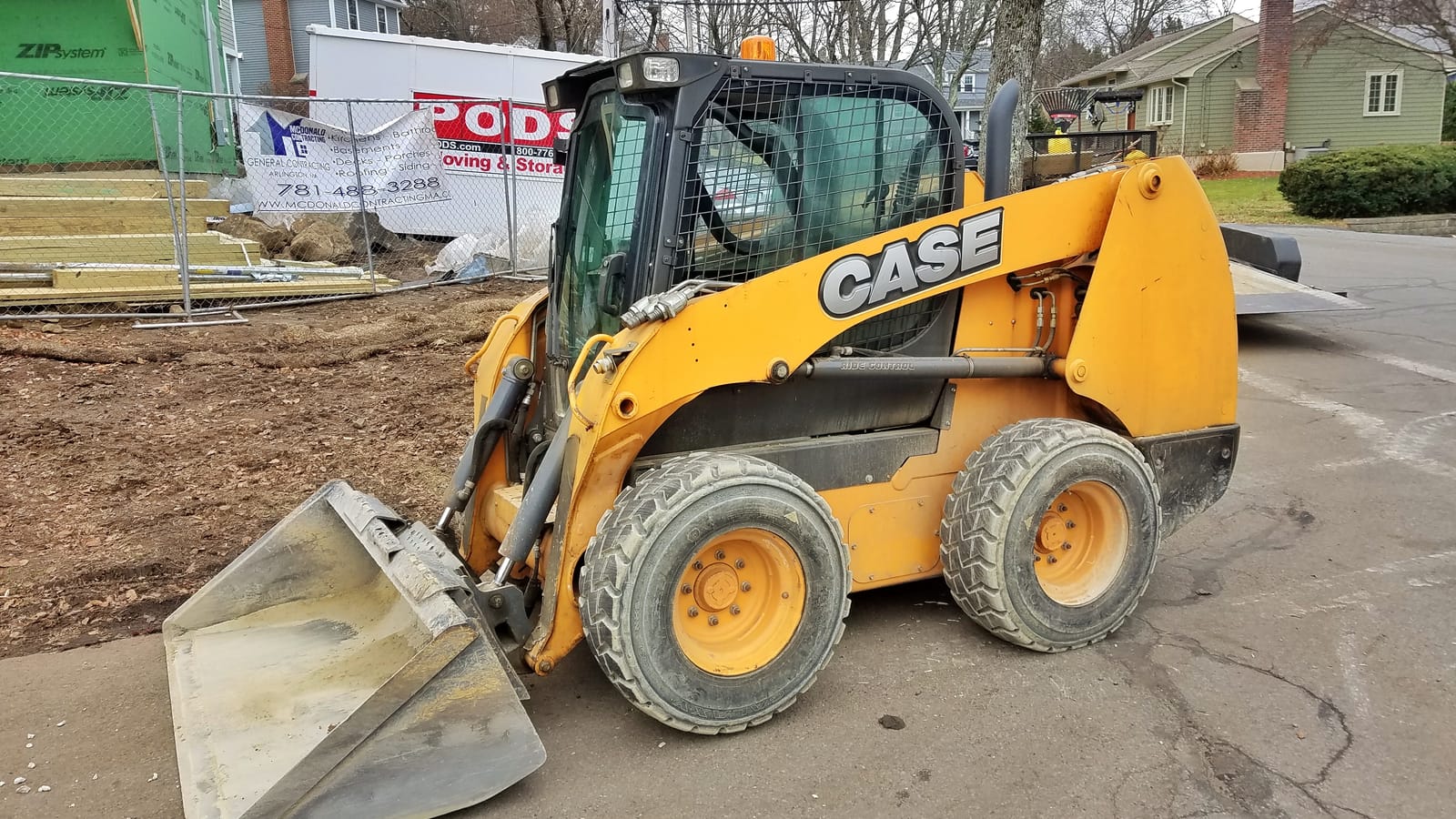
The skid-steer loader is a small loading machine with four wheels or two rubber tracks and no wheel steering; it turns by changing the speed of the two sides or reversing their direction so that the wheels skid on the ground, which gives it the ability to turn on the spot. It carries lift arms ending in a quick-attach plate that accepts dozens of attachments, and its life is measured in operating hours. In the Saudi market it is called by the name of the American brand that made it famous, “Bobcat”, whoever its manufacturer is.
Uses
- Loading and cleaning in tight spaces, urban sites and landscaping.
- Residential and commercial construction, utilities, demolition, tree clearing and road work with the larger classes.
- Farms, barns and moving feed and waste.
- Drilling holes with the auger attachment and digging small trenches with the trencher attachment.
- Breaking floors with a small breaker and sweeping yards with the broom.
- Handling pallets with the fork attachment inside yards.
- Light levelling and moving materials inside open warehouses and factories.
02Classes and sizes
The main manufacturer classifies its machines into three frame sizes by engine power and rated operating capacity, which is the maximum load the machine carries safely according to the test standard: a small frame for tight spaces, urban sites and landscaping, a medium for residential construction, utilities and farms, and a large for commercial construction, demolition, road work and large utilities.
| Class | Description | Typical use |
|---|---|---|
| Small frame | The lowest power and the smallest operating capacity | Tight spaces, urban sites and landscaping. |
| Medium frame | Medium power and a larger capacity | Residential construction, utilities and farms. |
| Large frame | The highest power and the largest capacity | Commercial construction, demolition, forestry and road work. |
Sub-classifications:
- Lift path: radial, which suits digging and loading at low height, and vertical, which suits loading at greater height such as into trucks.
- Undercarriage: wheels for hard ground, or rubber tracks for soft and sandy ground, and then it is called a “compact track loader”.
- Attachments: the manufacturer lists more than sixty attachments such as buckets, forks, the auger, the grapple and the broom.
03Main components
- 01The lift arms and the lift and tilt cylinders.
- 02The quick-attach plate for attachments and its locks, and the auxiliary hydraulic system for attachments.
- 03The bucket or the fitted attachment.
- 04The engine, the radiator and the air filters.
- 05The hydrostatic pumps and the drive motors on both sides.
- 06The chain case that transmits motion to the wheels, or the tracked undercarriage.
- 07The tyres or the rubber tracks and their rollers.
- 08The cab with its protective structure, the seat bar, the seat belt and the powered arm locks.
- 09The control levers or the joystick and the instruments.
04Periodic maintenance schedule
The usual ladder; the manual for the specific model sets the intervals and tasks that apply, and the manufacturer stresses that each model has its own specified service intervals and that values such as track tension are taken from the model’s operation and maintenance manual.
| Interval | Typical tasks |
|---|---|
| Every 10 hours / daily |
|
| Every 50 hours / weekly |
|
| Every 250 hours |
|
| Every 500 hours |
|
| Every 1000 hours |
|
| Every 2000 hours |
|
The manufacturer’s manual governs. The actual intervals and tasks are set by the operation and maintenance manual for your machine’s model, and they are shortened in heavy dust, high heat and continuous operation. This table shows the general order only and does not replace the manual.
05Daily pre-start checklist
14 items
06Common operating mistakes that cause breakdowns
- Continuous skid turning on asphalt and concrete, which wears out the tyres or the rubber tracks quickly.
- Loading above the rated operating capacity or fitting an attachment heavier than specified, so the machine tips forward.
- Travelling with the arms raised and the load high, or descending a slope with the load facing downhill.
- Leaving the cab or passing under raised arms without a mechanical lock on the arms.
- Running a hydraulic attachment that needs a greater flow than the machine provides, or connecting it while the lines are pressurised.
- Neglecting to clean the radiator in a dusty environment, so the hydraulic temperature rises.
- Not making sure the quick-attach plate is locked, so the attachment falls.
- Stopping a hot engine immediately with no cool-down period.
07Regulatory requirements
Regulatory procedures to check when owning or operating this machine in the Kingdom.
08What to weigh when renting or buying
- The rated operating capacity relative to the heaviest material and attachment, and the lift path according to the loading height required.
- Wheels or tracks according to the ground: sand and soft ground need tracks.
- The width of the machine relative to the entrances and passages it will work in.
- The auxiliary hydraulic flow relative to the attachments that will be used.
- Reading the hour meter together with the maintenance record, and the condition of the tyres or tracks and rollers.
- Clearance in the arm pins, cylinder leaks, and equal response of the hydrostatic motors on both sides.
- The quick-attach plate locks and the soundness of the attached attachments.
- Availability of spare parts for the brand in the area; the demand for Bobcat spare parts is clear in Riyadh, Jeddah and Dammam.
- When renting or in a rental business: the hours and the minimum, transport on a trailer, and who bears the tyres and attachments.
Settle these factors first, then enter your own numbers in the Own vs rent calculator or the Equipment operating cost per hour calculator.
09Frequently asked questions
After the American brand that made this machine famous, so its name became a generic name in the market regardless of the manufacturer.
Three frame sizes, small, medium and large, by power and operating capacity, two lift paths, radial and vertical, and two undercarriages, wheels or rubber tracks.
The Bobcat is a small machine that turns on the spot by skidding its wheels, accepts many attachments and works in tight spaces, while the wheel loader is a large machine with a steering joint and a wide bucket for heavy loading.
The forklift is dedicated to lifting pallets vertically on a mast, while the Bobcat is a multi-attachment loading machine that can be fitted with forks for limited handling inside yards, not as a replacement for the forklift in a warehouse.
Both exist; wheels for hard ground and asphalt, and rubber tracks for sand and soft ground, and the tracked model is called a “compact track loader”.
Inspection is daily, and the usual service points are every 250, 500, 1000 and 2000 hours, and each model has its own schedule in the operation and maintenance manual.
The oils, the radiator, the track tension or tyres, leaks, the attachment locks, the seat bar, the arm locks and the alarms, as in the list above.
This page does not offer a commercial assessment; operationally, the business depends on the machine’s utilisation in hours, the cost of tyres or tracks and attachments, and a documented maintenance record for each machine to calculate the actual cost per hour.