- Names used in Saudi Arabia
- Mini excavatorCompact excavatorSmall excavatorMicro excavatorBokalin mini (Saudi term)Bokalin saghirHafar saghir
- Formal name
- حفّارة صغيرة
- English name
- Mini excavator
- Family
- Heavy equipment · Digging & loading
- Measured by
- Operating hours
01Definition and uses
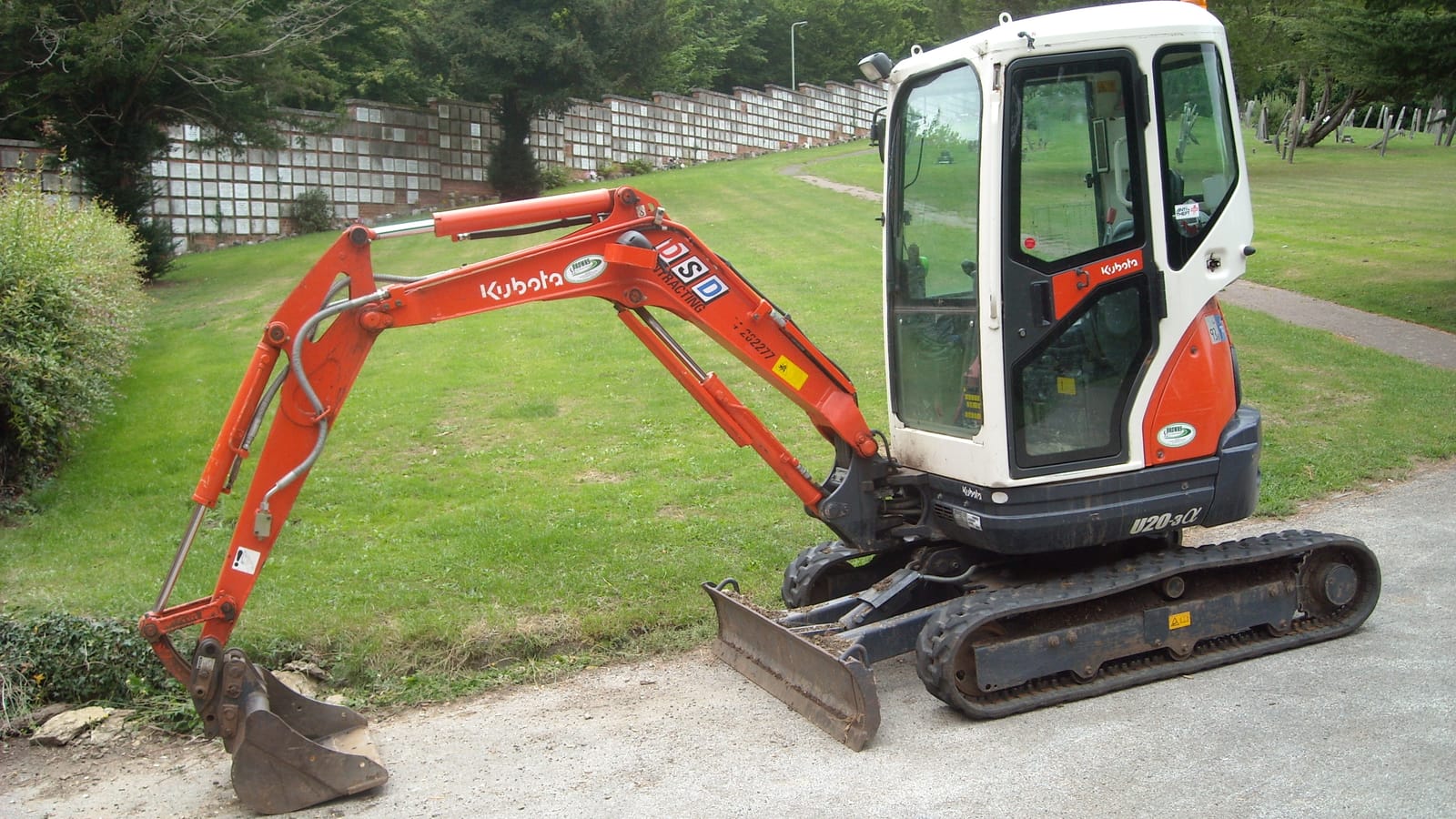
The mini excavator is a small excavator on tracks or wheels, with an operating weight of up to about eight and a half tonnes, and most have a front dozer blade and a boom that swings right and left independently of the body. One that weighs less than a tonne is called a micro. All its movements work by transferring hydraulic fluid, so the cylinders, the slew and the travel are driven by hydraulic motors. Its life is measured in operating hours. One part of daily care is cleaning the undercarriage of mud and gravel, because build-up speeds up wear. In the Saudi market “bokalin mini”, “bokalin saghir” and “hafar saghir” are said for the same machine, and it differs from the large Bokalin in that it works in tight places.
Uses
- Digging trenches for water, sewage, electricity and communication networks.
- Digging foundations for houses and small buildings.
- Working near walls and buildings thanks to offset digging.
- Backfilling and grading with the front blade.
- Light demolition and breaking with the breaker attachment.
- Digging with an auger, a grapple or specialised buckets.
- Work inside tight sites, passages, gardens and farms.
- Loading light materials into small trucks inside yards.
02Classes and sizes
The reference limits the class to about eight and a half tonnes of operating weight, and below one tonne is called a micro, and the weight of each model is published under different names between manufacturers, so direct comparison between them is not sound.
| Class | Description | Typical use |
|---|---|---|
| Micro | Weighs less than a tonne and is narrow enough to pass through doors | Very tight places and service work inside buildings. |
| Very small to medium | Up to about eight and a half tonnes | Trenches and foundations in cities. |
| Conventional tail swing | The rear counterweight swings beyond the tracks when turning | Work in open spaces. |
| Zero tail swing | The body stays within the width of the tracks in a full turn | Working near walls and buildings. |
| Tracked | Rubber or steel tracks | Uneven and soft ground. |
| Wheeled | Rubber wheels instead of tracks | Paved roads and fast movement between sites. |
03Main components
- 01The rotating upper structure, which holds the cab, the engine and the pump.
- 02The slew bearing that connects it to the undercarriage.
- 03The undercarriage: the rubber or steel tracks, the sprockets, the rollers and the idlers.
- 04The work group: the boom, the stick and the attachment.
- 05The side swing frame that moves the work group right and left.
- 06The front dozer blade.
- 07The quick coupler for changing attachments.
- 08The pump, the valves and the tank of the hydraulic system.
- 09The engine, the cooling system and the air filters.
- 10The protective structure, the seat belt and the operator seat.
04Periodic maintenance schedule
The usual ladder, and the manual for the specific model sets the intervals and tasks that apply.
| Interval | Typical tasks |
|---|---|
| Every 10 hours / daily |
|
| Every 50 hours / weekly |
|
| Every 250 hours |
|
| Every 500 hours |
|
| Every 1000 hours |
|
| Every 2000 hours |
|
The manufacturer’s manual governs. The actual intervals and tasks are set by the operation and maintenance manual for your machine’s model, and they are shortened in heavy dust, high heat and continuous operation. This table shows the general order only and does not replace the manual.
05Daily pre-start checklist
14 items
06Common operating mistakes that cause breakdowns
- Working on sloping ground or on an edge without stability, so the excavator overturns.
- Using the slew to push the bucket against a wall or rock, which damages the slew bearing.
- Travelling with the load raised on uneven ground.
- Lifting loads above the lifting capacity chart of its model.
- Running the breaker without suitable water or pressure, or with an attachment unsuitable for the size of the excavator.
- Leaving the track slack or tensioned beyond the limit, which damages the undercarriage.
- Neglecting to grease the boom and the bucket daily.
- Driving on sharp rocky ground unnecessarily, so the rubber of the track wears.
07Regulatory requirements
Regulatory procedures to check when owning or operating this machine in the Kingdom.
08What to weigh when renting or buying
- The operating weight and the track width against the narrowest passage it will go through.
- Conventional or zero tail swing according to how close the work is to walls.
- The condition of the undercarriage: the tracks, the sprockets and the rollers.
- The clearance of the slew bearing and the boom and bucket pins.
- The attachments available, the type of quick coupler and the match of the auxiliary hydraulic lines.
- Leaks from the cylinders and the pump and the performance of the slew and the travel.
- The hour-meter reading with the maintenance record, and the availability of spare parts for the brand.
- When renting: moving the machine there and back, how hours are counted, and who bears the fuel, the operator and the attachments.
Settle these factors first, then enter your own numbers in the Own vs rent calculator or the Equipment operating cost per hour calculator.
09Frequently asked questions
In the Saudi market it is called “bokalin mini”. The English name is in the name field above, and it is the name used in manufacturers’ bulletins for this class.
The small one works in tight sites with an upper weight limit, and the large one is for heavy digging and great depths; the most important advantage of the small one is offset digging by swinging the boom.
A design in which the body stays within the width of the tracks during a full turn, so the operator works near walls without hitting them.
Buckets, the breaker, the grapple, the auger and the tilt and rotator attachment, through a quick coupler.
According to its weight and dimensions in the model’s bulletin, and usually on a low-bed or a suitable trailer with a permit if required.
The micro is under a tonne in weight and very narrow so that it passes through restricted places, and the mini is above that up to about eight and a half tonnes.
The oils, the leaks, the tracks, the pins, the quick coupler, the coolers and safety, as in the list above.