- Names used in Saudi Arabia
- BulldozerCrawler dozerDozerCrawler bulldozerBuldozer (Saudi term)Jarrafa
- Formal name
- جرّافة مجنزرة
- English name
- Bulldozer (crawler dozer)
- Family
- Heavy equipment · Digging & loading
- Measured by
- Operating hours
01Definition and uses
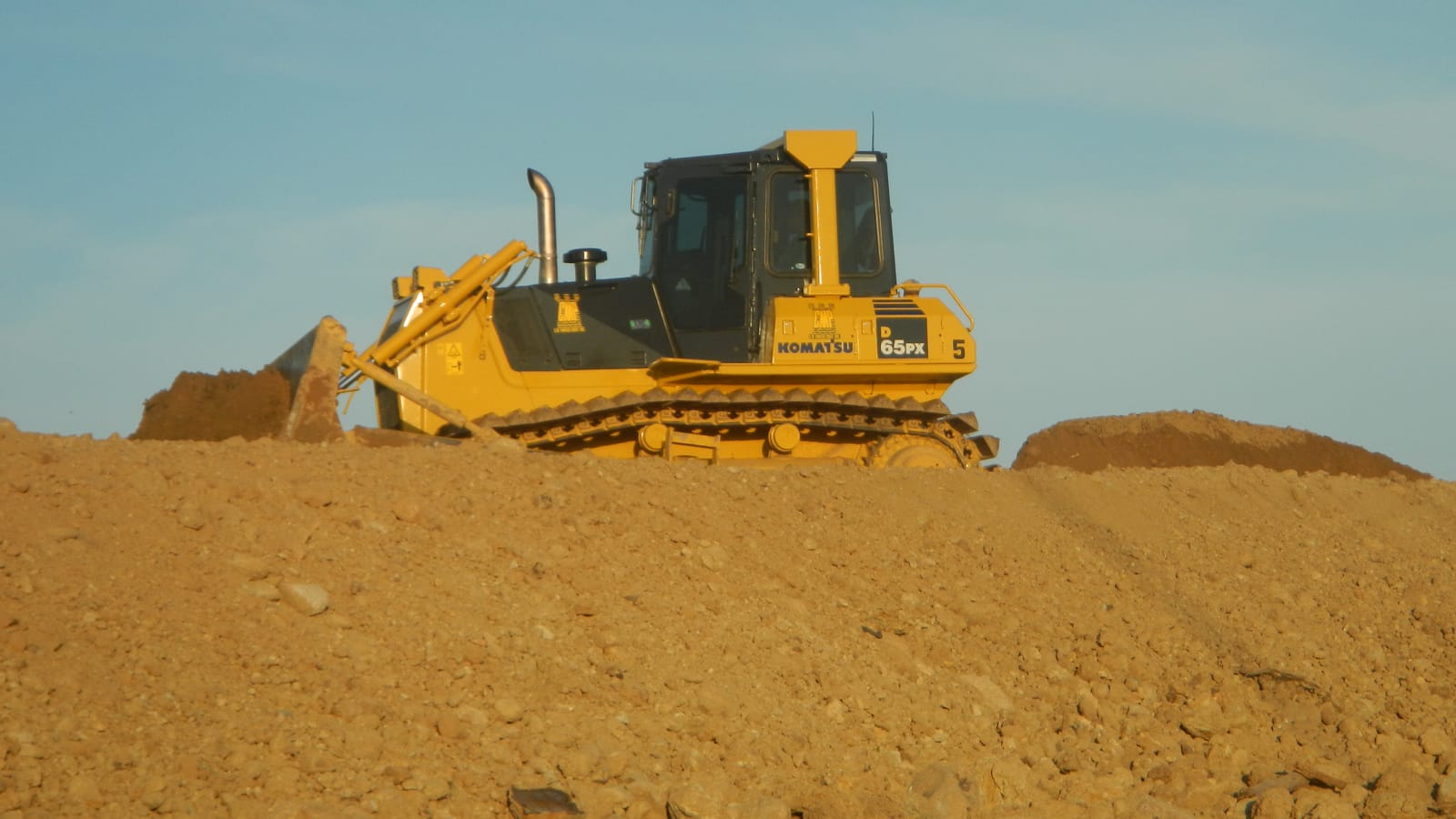
The bulldozer is a powerful tracked machine that carries a wide blade at the front to push soil and rock and level the ground, and usually a ripper claw at the rear to break up hard ground. Its job is pushing material over short distances, preparing sites and cutting roads, not digging or loading, and its life is measured in operating hours. Manufacturers state that it is designed to work from fine grading to pushing in excavated tracks, and describe it as the workhorse of the fleet. The model numbers the market asks about, “D9” and “155”, indicate specific size classes at two particular manufacturers.
Uses
- Preparing sites and stripping the surface layer before construction.
- Cutting dirt roads and levelling equipment tracks on projects.
- Pushing fill and spreading it in layers before compaction.
- Ripping rock and hard ground with the rear claw before digging or loading.
- Stockpiling material and pushing it towards the wheel loader in quarries and mines.
- Clearing trees and debris and opening tracks.
- Shaping slopes, earth embankments and channels.
02Classes and sizes
Manufacturers classify dozers into small, medium and large sizes and surface-mining dozers, in addition to models fitted with integrated automatic blade control. The classification depends on operating weight, engine power and blade capacity, and the figures are in the sheet of each model.
| Class | Description | Typical use |
|---|---|---|
| Small | A light dozer with a narrow blade | Fine grading, landscaping and working near buildings. |
| Medium | The most common class in contracting and roads | Preparing sites, cutting roads and backfilling. |
| Large | A heavy dozer with a large blade and a strong ripper | Quarries, major projects and ripping rock. |
| Surface mining | The largest class | Mines and pushing very large quantities. |
Sub-classifications:
- Blade type: straight for heavy pushing, and semi-universal and universal with wings to carry a greater quantity of loose material, and an angle blade that can be tilted to push material sideways.
- Undercarriage: standard, or low ground pressure with wide shoes for soft and sandy ground.
- Automatic blade control by satellite for grading to the required level.
03Main components
- 01The blade with its cutting edge and corners, the push arms, and the lift, tilt and angle cylinders.
- 02The rear ripper, its teeth and its cylinders.
- 03The undercarriage: tracks and their shoes, rollers, front idler, final drive, track frames, tensioning mechanism.
- 04The engine, coolers and air filters.
- 05The transmission: hydrostatic, or with a torque converter and gearbox, and the final drive on both sides.
- 06The steering and brake system.
- 07The hydraulic system for the blade and the ripper.
- 08The cab with its protective structure, the operator seat and the control levers.
- 09The electrical and lighting system, the reverse alarm and the automatic control units if fitted.
04Periodic maintenance schedule
The usual ladder; the manual for the specific model sets the intervals and tasks that apply, and the intervals shorten in heavy dust and work in rock.
| Interval | Typical tasks |
|---|---|
| Every 10 hours / daily |
|
| Every 50 hours / weekly |
|
| Every 250 hours |
|
| Every 500 hours |
|
| Every 1000 hours |
|
| Every 2000 hours |
|
The manufacturer’s manual governs. The actual intervals and tasks are set by the operation and maintenance manual for your machine’s model, and they are shortened in heavy dust, high heat and continuous operation. This table shows the general order only and does not replace the manual.
05Daily pre-start checklist
15 items
06Common operating mistakes that cause breakdowns
- Repeated sharp turning under load, which strains the final drive and throws the track.
- Travelling at high speed over long distances or working on sharp rocky ground without suitable shoes, which wears out the undercarriage quickly.
- Over-tightening the track “to avoid it coming off”, which speeds up wear of the rollers, idlers and bolts.
- Pushing with the blade angled into rock or using the blade for striking.
- Ripping with more than one tooth in hard rock, or side pulling with the ripper.
- Working across a slope with the machine loaded, which exposes it to overturning.
- Neglecting to clean hardened mud from the undercarriage, so tension increases and the seals are damaged.
- Stopping a hot engine immediately with no cool-down period.
07Regulatory requirements
Regulatory procedures to check when owning or operating this machine in the Kingdom.
08What to weigh when renting or buying
- The size class according to the quantity of material, the push distance and the type of ground, the blade type, and whether there is a ripper.
- The condition of the undercarriage by measurement, since it is the largest repair item on dozers: shoes, rollers, idlers, pins and bushings.
- Leaks from the final drives and the blade cylinders, and the transmission sound in shifting.
- Clearance in the blade pins and the push arms and cracks in the welds.
- Reading the hour meter together with the maintenance record and oil analysis if available.
- The condition of the cutting edge, the corners and the ripper teeth.
- Availability of spare parts for the brand in the area; the demand for bulldozer spare parts is clear in the enquiries.
- When renting: the hours and the minimum, and who bears transport on the low-bed, the operator and the undercarriage.
Settle these factors first, then enter your own numbers in the Own vs rent calculator or the Equipment operating cost per hour calculator.
09Frequently asked questions
“Bulldozer” (“buldozer”) is the market name, and it is called “jarrafa” (crawler dozer) in some official documents.
Small, medium, large and surface mining, with the blade straight, universal or angle, the undercarriage standard or low-pressure, and models with automatic blade control.
The bulldozer pushes, levels and rips the ground with a front blade and does not dig deep holes or load trucks, while the Bokalin digs and loads with an arm and bucket on a rotating structure.
The wheel loader carries material in a bucket and moves it to the truck, while the bulldozer pushes it in front of it along the ground and does not lift it.
They are model numbers at two particular manufacturers that indicate a specific size class in the range of each, and they are not generalised to the other manufacturers; the specifications are in the model’s sheet.
Because of sharp turning under load, high speed, sharp rocky ground, incorrect track tension, and hardened mud that is not cleaned.
Inspection is daily, and the usual service points are every 250, 500, 1000 and 2000 hours, with periodic measurement of the undercarriage, and the intervals that apply set in the model’s manual.
Ripping hard ground and fractured rock into pieces that the blade can push or the wheel loader can load, instead of blasting or breaking in many cases.