- Names used in Saudi Arabia
- Crawler craneTrack craneLattice boom crawler craneKiran janzir (Saudi term)
- Formal name
- رافعة مجنزرة
- English name
- Crawler crane
- Family
- Heavy equipment · Cranes
- Measured by
- Operating hours
01Definition and uses
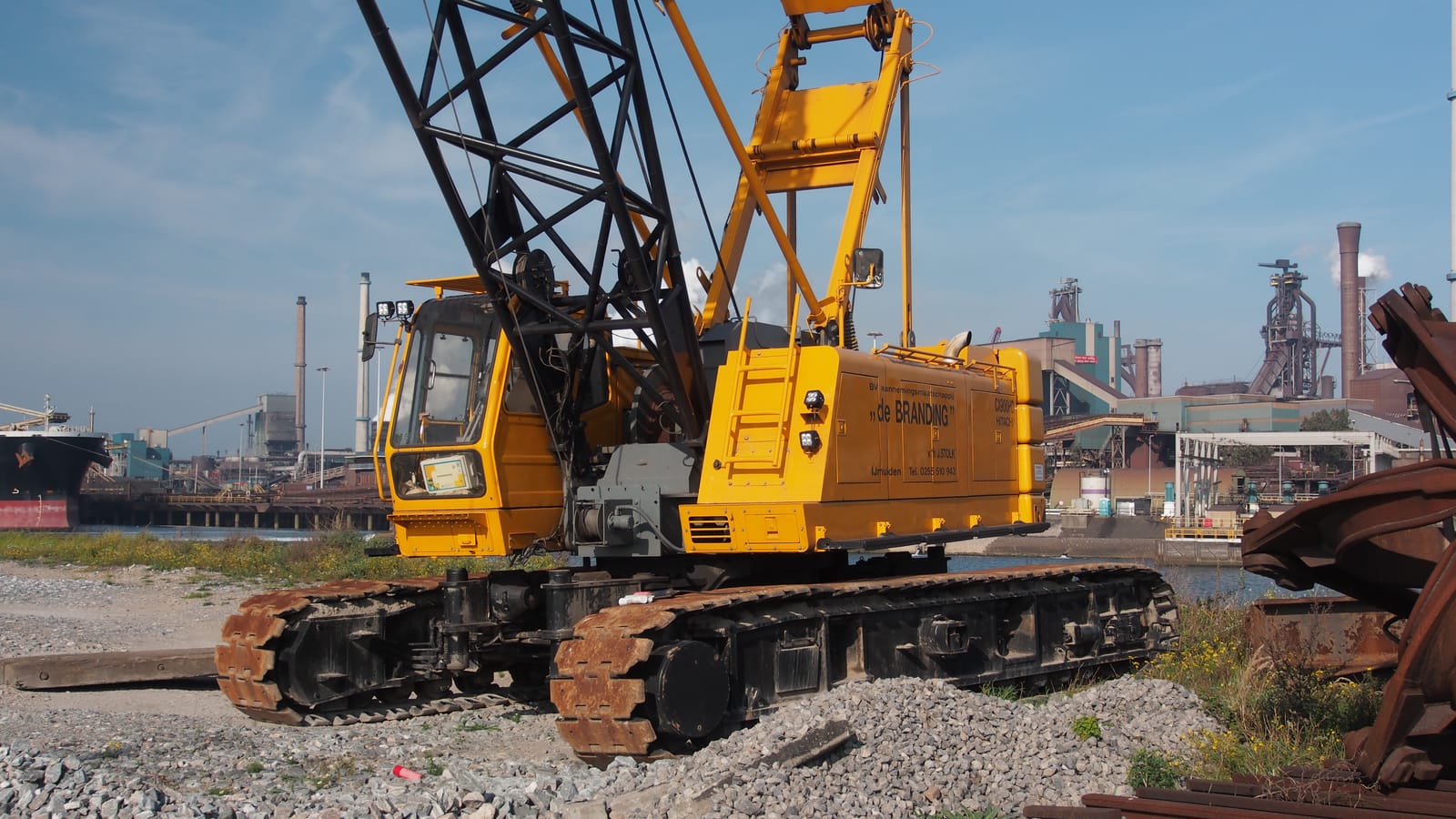
The crawler crane is a crane that carries its boom on a lower structure fitted with tracks that give it stability and mobility together, and it is a type of mobile crane, usually working with a lattice boom to which a jib can be added. According to the reference its lifting capacity extends from about forty to four thousand long tons depending on the model. It is distinguished by working on sites with the least preparation, standing on its tracks with no side outriggers, and travelling with the load. It is measured in operating hours because it does not travel on public roads by itself. In the Saudi market “kiran janzir” is said, and it is confused with “bokalin janzir” (tracked Bokalin) and “shuwal janzir” (tracked loader) because the word “janzir” only means tracks, and they are machines of different function.
Uses
- Lifting very large loads on long projects such as power stations, factories and bridges.
- Working on unprepared or soft ground, since the wide tracks spread the weight over a large area.
- Handling heavy equipment, vessels and transformers inside industrial sites.
- Structural erection of steel structures, columns and precast concrete beams.
- Foundation work by fitting piling and drilling equipment, if fitted to it.
- Lifting the load and travelling with it inside the site.
- Demolition work with a demolition ball or a clamshell with a special attachment in some models.
02Classes and sizes
Crawler cranes are classified by nominal lifting capacity, boom length, track width and operating weight, and their capacities range from about forty to four thousand long tons. The actual capacity is not a single figure but a chart that changes with the radius, the boom length, the attachments and the counterweight.
| Class | Description | Typical use |
|---|---|---|
| Small | A light crawler crane, often transported assembled | Tight sites and medium work. |
| Medium | The most used in construction projects | Steel structures and factories. |
| Large | A long lattice boom and a large counterweight | Power stations, bridges and industrial facilities. |
| Very large | The top class in capacity, dismantled for transport | Exceptional projects. |
03Main components
- 01The lower structure with the tracks, rollers, idlers and the drive sprocket.
- 02The rotating upper structure and the slew bearing.
- 03The lattice boom, the jib and the connections.
- 04The counterweight and its fixings.
- 05The main and auxiliary hoists with drums, wire ropes, pulleys, the hook and its latch.
- 06The engine, the hydraulic pumps and the track and slew motors.
- 07The cab, the control system, the load moment indicator, and the safety and warning devices.
- 08The boom angle indicator and the anti-two-blocking device.
- 09The track tensioning and greasing systems.
- 10The assembly equipment such as pins, bolts and boom connections.
04Periodic maintenance schedule
The following ladder is the usual one, and the manual for the specific model sets the intervals and tasks that apply; the intervals are shorter in dust, sand and continuous heavy work.
| Interval | Typical tasks |
|---|---|
| Every 10 hours / daily |
|
| Every 50 hours / weekly |
|
| Every 250 hours |
|
| Every 500 hours |
|
| Every 1000 hours |
|
| Every 2000 hours |
|
| Annually |
|
The crane is also inspected after every assembly by a qualified person to make sure its arrangement conforms to the manufacturer’s criteria, and after any modification or repair related to safety and before first use.
The manufacturer’s manual governs. The actual intervals and tasks are set by the operation and maintenance manual for your machine’s model, and they are shortened in heavy dust, high heat and continuous operation. This table shows the general order only and does not replace the manual.
05Daily pre-start checklist
13 items
The construction crane regulation requires a visual inspection by a competent person before every shift, completed before or during operation, without dismantling unless a need appears, covering as a minimum:
06Common operating mistakes that cause breakdowns
- Neglecting to assess ground firmness; insufficient ground preparation is a main cause of crane overturning accidents on construction sites.
- Lifting outside the load chart by increasing the radius or with a boom configuration that contradicts the chart.
- Travelling with the load on uneven ground or over covered holes and trenches.
- Side lifting or dragging the load away from the boom centre, which strains the lattice boom.
- Disabling the safety devices or the load moment indicator.
- Operating in strong wind with a load of large surface area.
- Leaving the tracks slack or tensioned more than needed, so the undercarriage wears.
- Working near overhead power lines without a safe clearance and a controlling signal.
07Regulatory requirements
Regulatory procedures to check when owning or operating this machine in the Kingdom.
08What to weigh when renting or buying
- Studying the lift first: the weight of the load, radius, height and obstacles, then choosing the crane from the load chart and not from the nominal figure.
- The condition of the ground, the access routes and the site preparation requirements before the crane arrives.
- The transport method: which parts are dismantled, which trailers are needed, and how long assembly takes.
- The condition of the undercarriage: the tracks, rollers, idlers and sprocket.
- The condition of the boom, connections, ropes and pulleys, and the record of their replacement.
- A valid inspection certificate, the assembly record and the inspection after it, and the operating hours.
- The availability of a qualified operator, a signaller and an assembly crew.
- When renting: whether the quote includes the counterweight, the jib, transport and assembly, and who bears the insurance and the fuel.
Settle these factors first, then enter your own numbers in the Own vs rent calculator or the Equipment operating cost per hour calculator.
09Frequently asked questions
A crane that carries its boom on a tracked structure that gives it stability and mobility, works on unprepared ground and travels with the load, and its capacities are measured in tens to thousands of tonnes.
The crawler is steadier on soft ground, needs no outriggers and travels with the load, but it is heavy and needs dismantling and trucks to transport it, while the wheeled mobile crane travels on roads by itself but needs outriggers and support pads.
The crawler crane lifts loads with a wire rope and a load chart, while the tracked Bokalin is an excavator that digs and loads its bucket; “janzir” in both names only means tracks.
The tracked excavator is an excavator on tracks, and the tracked loader is a loading dozer on tracks, and both are digging and loading machines and not lifting machines like the crane.
The large one is dismantled at least into the boom and the cab and transported by trucks, trains or ships to its site, then assembled and inspected before use.
A visual inspection before every shift, a documented monthly inspection kept for at least three months, and a full inspection by a qualified person every twelve months, as in the reference regulation.