- Names used in Saudi Arabia
- Screening machineVibrating screenScreenCrusher screenScreening bucketGhirbal (Saudi term)Bukit ghirbal
- Formal name
- غربال فرز المواد
- English name
- Screening plant
- Family
- Heavy equipment · Crushing & screening
- Measured by
- Operating hours
01Definition and uses
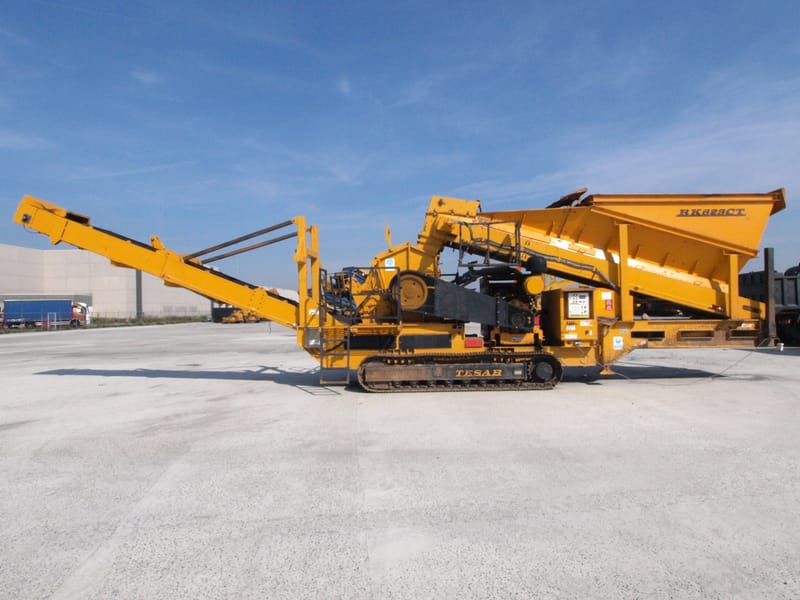
The screening machine separates granular or crushed materials into grades according to particle size, a process known as mechanical screening. The machine is made up of a motor that generates vibration, a screening mesh that separates the particles, and a frame that carries the mesh and the motor. It is used in mining, ore processing, agriculture and recycling. Its operating hours are measured by the engine meter or the vibration meter. In the Saudi market the word “ghirbal” is applied to three things: the fixed or mobile crusher screen, the rotary drum screen, and the “bukit ghirbal” (screening bucket) that is fitted to the Bokalin or the wheel loader; the last is an attachment and not an independent machine, and most of the enquiries revolve around it.
Uses
- Sorting crusher output into different commercial sizes.
- Primary screening to remove large lumps before the crusher.
- Separating sand, soil and gravel at quarries and aggregate dumps.
- Cleaning excavated soil and separating stones and roots from it for reuse.
- Sorting demolition and construction waste into recyclable parts.
- Sorting municipal waste and preparing organic compost.
- Separating fine dust from ores before the later stages.
02Classes and sizes
Screens are classified by motion, mounting and type of application, and the output, mesh opening and number of decks of each model are set in the manufacturer’s bulletin. Screening is divided into dry and wet.
| Class | Description | Typical use |
|---|---|---|
| Inclined vibrating | An inclined frame that vibrates in a wave motion | Sorting in crusher lines. |
| Horizontal vibrating | A frame of slight slope that vibrates in a sideways reciprocating motion | Sorting fine materials. |
| High frequency | The frame is fixed and the mesh alone vibrates | Fine particles. |
| Rotary drum | A perforated inclined drum that turns so the fine particles leave through its holes | Waste, ores and compost. |
| Mobile on tracks | A screen on a tracked chassis that is moved between sites | Contracting and small quarries. |
| Fixed in the crusher line | A screen mounted on a fixed structure with the conveyors | Quarries and aggregate plants. |
| Screening bucket | An attachment fitted to the Bokalin or the wheel loader that screens the material while loading | Cleaning soil and separating fill on site. |
03Main components
- 01The feed hopper and the material barrier.
- 02The frame that carries the mesh and contains the vibration motor.
- 03The screening medium: steel mesh, rubber panels or polyurethane.
- 04The vibration motor and its weights, or the drum rotation motor.
- 05Springs or rubber cushions that isolate the vibration from the structure.
- 06The product and reject conveyors leaving the screen.
- 07A diesel engine and hydraulics in the mobile models.
- 08The chassis and the tracks in the mobile models.
- 09The safety systems: guards for the rotating parts and emergency stop buttons.
- 10The control panel.
04Periodic maintenance schedule
The usual ladder, and the manual for the specific model sets the intervals and tasks that apply; the intervals are shorter in heavy dust and summer heat.
| Interval | Typical tasks |
|---|---|
| Every 10 hours / daily |
|
| Every 50 hours / weekly |
|
| Every 250 hours |
|
| Every 500 hours |
|
| Every 1000 hours |
|
| Every 2000 hours |
|
The manufacturer’s manual governs. The actual intervals and tasks are set by the operation and maintenance manual for your machine’s model, and they are shortened in heavy dust, high heat and continuous operation. This table shows the general order only and does not replace the manual.
05Daily pre-start checklist
13 items
06Common operating mistakes that cause breakdowns
- Over-feeding or uneven feeding, so the material piles up and the efficiency of the sorting falls.
- Running with a torn mesh or one of the wrong size, so off-size material leaks into the product.
- Screening wet, sticky material with a fine mesh, so the openings block.
- Dropping large lumps from a height straight onto the mesh with no primary screening.
- Stopping the machine with material on it and then restarting it loaded.
- Neglecting to grease the vibration bearings, or filling them with more oil than needed.
- Leaving the mesh bolts slack, so the frame is damaged.
- Setting the machine on soft or sloping ground.
07Regulatory requirements
Regulatory procedures to check when owning or operating this machine in the Kingdom.
08What to weigh when renting or buying
- The nature of the material: dry or wet, and whether it contains clay or roots that block the mesh.
- The sizes required in the product and the number of decks needed for them.
- The output required per hour against the manufacturer’s bulletin.
- Mobile against fixed according to how often the site is moved.
- The condition of the frame, its welds, the vibration bearings and its springs.
- The condition of the mesh and the availability of replacements in the size required.
- For a screening bucket: the match of the attachment coupler to the Bokalin or the wheel loader, its weight and the hydraulic capacity.
- The engine hours with the maintenance record.
- When renting: who bears the worn mesh, the fuel and the operator.
Settle these factors first, then enter your own numbers in the Own vs rent calculator or the Equipment operating cost per hour calculator.
09Frequently asked questions
A machine that separates materials into grades according to particle size by vibration or by a rotating drum.
An attachment fitted in place of the ordinary bucket that screens the material as it is carried, separating the fine from the coarse on site without a full screening line, and its weight and the hydraulic capacity determine the machine that carries it.
The vibrating one is a vibrating frame with a flat mesh, and the rotary drum is an inclined perforated drum that turns, through which the fine particles leave.
Material sticking in the mesh openings and stopping particles from passing. Its cause is moisture, clay or a wrong size, and it is treated by cleaning the mesh and adjusting the feed or changing the mesh type.
The material is screened before the crusher to remove large lumps, and after it for the final separation into commercial sizes.
The inclined, horizontal and high-frequency vibrating, and the rotary drum. Among them are the mobile on tracks and the fixed in a crusher line, and the screening bucket attached to the Bokalin or the wheel loader is added.
According to the size required for the product and the nature of the material and its moisture, and the manufacturer recommends the mesh type for the application.
The frame and its welds, the springs, the vibration bearings, the mesh, the engine hours, the maintenance record, and the condition of the tracks if it is mobile.