- Names used in Saudi Arabia
- Overhead craneBridge craneOverhead travelling craneEOT craneRafi‘a ‘ulwiyya (Saudi term)Kiran ‘ulwiRafi‘a jisriyya
- Formal name
- رافعة جسرية علوية
- English name
- Overhead (bridge) crane
- Family
- Heavy equipment · Cranes
- Measured by
- No meter
01Definition and uses
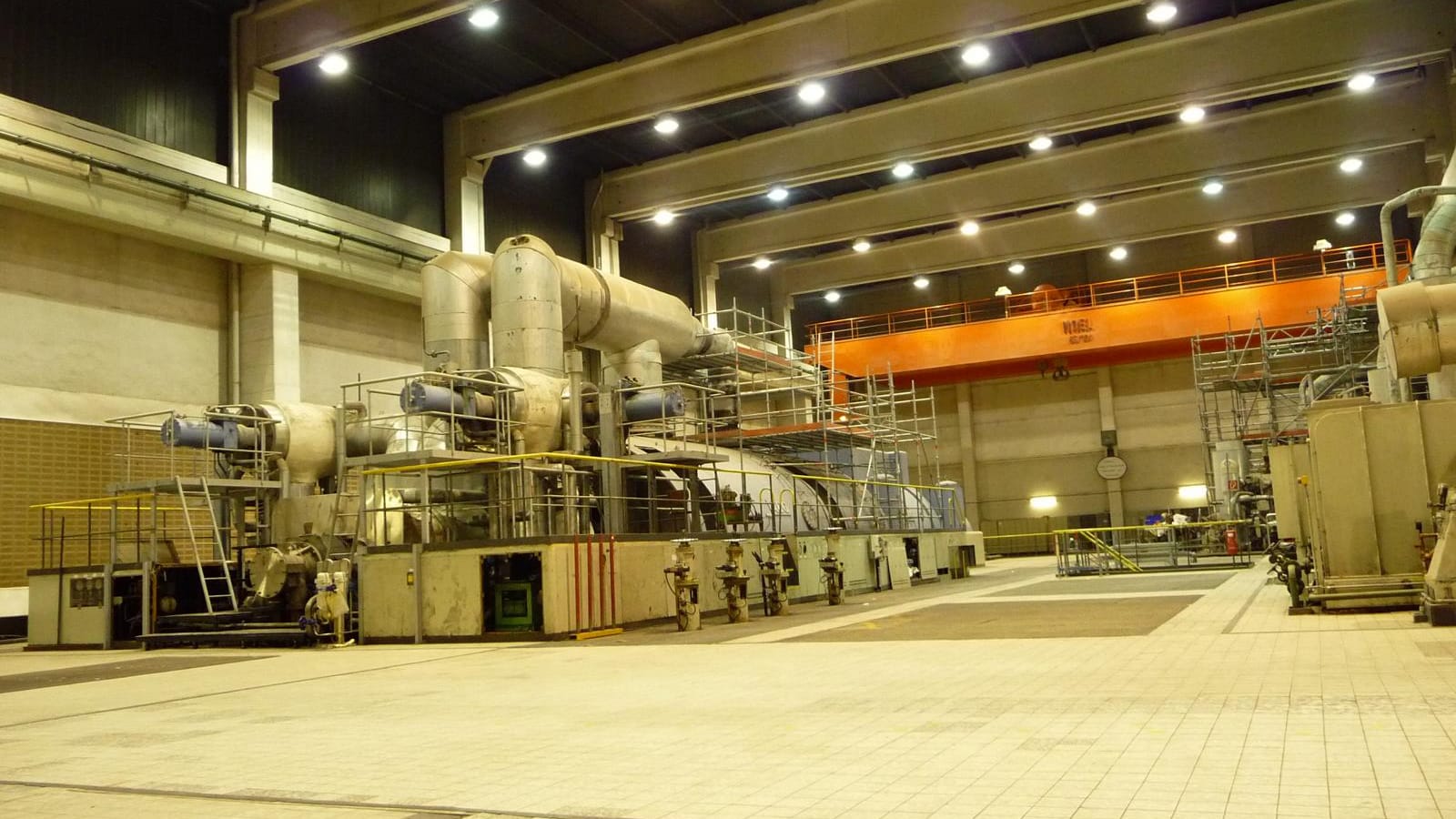
The overhead crane, also called a bridge crane, is a crane used in factories and workshops, made up of two parallel rails on longitudinal beams fixed to steel columns, with a moving bridge between them on which runs the hoist that lifts the load. If the bridge is carried on two legs that run on two ground rails, it is called a gantry crane. It is used in manufacturing and maintenance work, where efficiency and downtime are decisive factors. It is a fixed machine inside the facility that does not run on roads and needs no odometer, and it may have an hour meter or its operation may be recorded by hand. The American overhead crane regulation provides for frequent and periodic inspections of it.
Uses
- Lifting and moving heavy parts along production lines in factories.
- Handling dies and equipment inside maintenance workshops and when dismantling machinery.
- Loading trucks from docks inside warehouses.
- Lifting coils, plates and pipes in steel workshops.
- Handling precast concrete elements inside factories.
- Serving power stations and large generator halls.
- Handling materials in open yards with the gantry type.
02Classes and sizes
Overhead cranes are classified by the number of girders, the suspension method and the type of use, and the capacity, span and lifting height are set by the crane’s plate and the designer’s bulletin. A general reference states that the single-girder type is the most common and is for lighter loads, up to about 15 tonnes, and that the double-girder type lifts much larger loads of up to about 400 tonnes and over wider spans.
| Class | Description | Typical use |
|---|---|---|
| Single girder | A bridge of one girder running over the rails | Light and medium loads, and the most common. |
| Double girder | A bridge of two girders, with the hoist between or above them | Heavy loads and higher lifts. |
| Underslung | The rails are fixed to the building roof | Saving floor space with a smaller capacity. |
| Wall-mounted | Fixed to the wall or columns | A defined work area, and it can work beneath another crane. |
| Gantry | A bridge on two legs that run on two ground rails | Open yards and places with no supporting building. |
| Semi-gantry | A ground rail on one side and an overhead rail on the other | Use on the wall of an existing building. |
The crane is also divided by control method into cab-operated, pendant-controlled from the floor, fixed station and remote control.
03Main components
- 01The two travel rails and the supporting beams and the columns or brackets.
- 02The bridge and its girder or girders.
- 03The trolley that runs on the bridge and carries the hoist.
- 04The hoist with a wire rope or a chain, its drum and its hook.
- 05The bridge and trolley travel motors and speed reducers.
- 06The electromechanical brakes for hoisting and travel.
- 07The hoist limit switches, travel limits and buffers.
- 08The power supply: conductor bars or festoon cables.
- 09The operator cab, the pendant or the remote control unit.
- 10The crane’s metal plate, which carries the rated load.
04Periodic maintenance schedule
The overhead crane is laddered by its operating hours or by the corresponding time periods if it has no meter, and the intervals shorten with many cycles and loads near the rated load. The overhead crane regulation provides for a frequent inspection ranging between daily and monthly, and a periodic inspection whose intervals range between one month and twelve months depending on activity, service severity and environment. The following ladder is the usual one, and the manufacturer’s manual sets the intervals and tasks that apply.
| Interval | Typical tasks |
|---|---|
| Every 10 hours / daily |
|
| Every 50 hours / weekly |
|
| Every 250 hours |
|
| Every 500 hours |
|
| Every 1000 hours |
|
| Every 2000 hours |
|
The manufacturer’s manual governs. The actual intervals and tasks are set by the operation and maintenance manual for your machine’s model, and they are shortened in heavy dust, high heat and continuous operation. This table shows the general order only and does not replace the manual.
05Daily pre-start checklist
14 items
The overhead crane regulation lists the frequent inspection items, among them the hooks, chains, ropes, brakes, limit switches and control devices.
06Common operating mistakes that cause breakdowns
- Lifting a load above the rated load written on the crane.
- Using the hoist limit switch as an operating tool instead of as a protection.
- Wrapping the rope or chain around the load instead of using a suitable sling.
- Leaving the control buttons with the load suspended.
- Passing the load over people.
- Pulling the load sideways or dragging it instead of lifting vertically, which damages the rope and the wheels.
- Suddenly reversing the direction of travel, so the trolley and the load swing and the gears and brakes are affected.
- Neglecting to grease the wheels and gears and to clean the rails.
07Regulatory requirements
Regulatory procedures to check when owning or operating this machine in the Kingdom.
08What to weigh when renting or buying
- The required capacity, span and lifting height, which define the crane before any other comparison.
- The duty class: many cycles and loads near the limit need a heavier crane than occasional use.
- The soundness of the supporting building: whether it can bear the beams, the rails and their loads.
- The hoist type: wire rope or chain, and its durability for the number of cycles.
- The control method: pendant, cab or remote control.
- A recent inspection certificate and a maintenance record, and the availability of spare parts and technical service in the city.
- For a used crane: the condition of the rails and wheels and the wear of the hooks, ropes and brakes.
- When renting: overhead cranes are mostly installed fixed, so the choice is made between buying, installation and a maintenance contract.
Settle these factors first, then enter your own numbers in the Own vs rent calculator or the Equipment operating cost per hour calculator.
09Frequently asked questions
A bridge crane in factories and workshops, with a moving bridge on two rails on which the hoist runs.
The overhead crane relies on a supporting structure for the rails, and the gantry has its bridge on two legs that run on two ground rails; the two names are often used interchangeably.
Single girder, double girder, underslung and wall-mounted, with the gantry and semi-gantry added.
It is set by its plate and the designer’s bulletin, and a general reference states about 15 tonnes for the single girder and about 400 tonnes for the double girder.
A daily to monthly inspection of the hooks, ropes, brakes and limit switches, and a full periodic inspection at intervals between one month and twelve months depending on the service.
From suppliers of lifting equipment and its installation contractors, who are asked to specify the capacity, span, lifting height, duty class and the inspection certificate after installation.