- Names used in Saudi Arabia
- Water well drilling rigDrilling rigTruck-mounted drill rigArtesian well rigHafar abar (Saudi term)Hafara abarHafar abar artwaziyya
- Formal name
- حفّارة آبار
- English name
- Water-well drilling rig
- Family
- Heavy equipment · Specialised drilling
- Measured by
- Operating hours
01Definition and uses
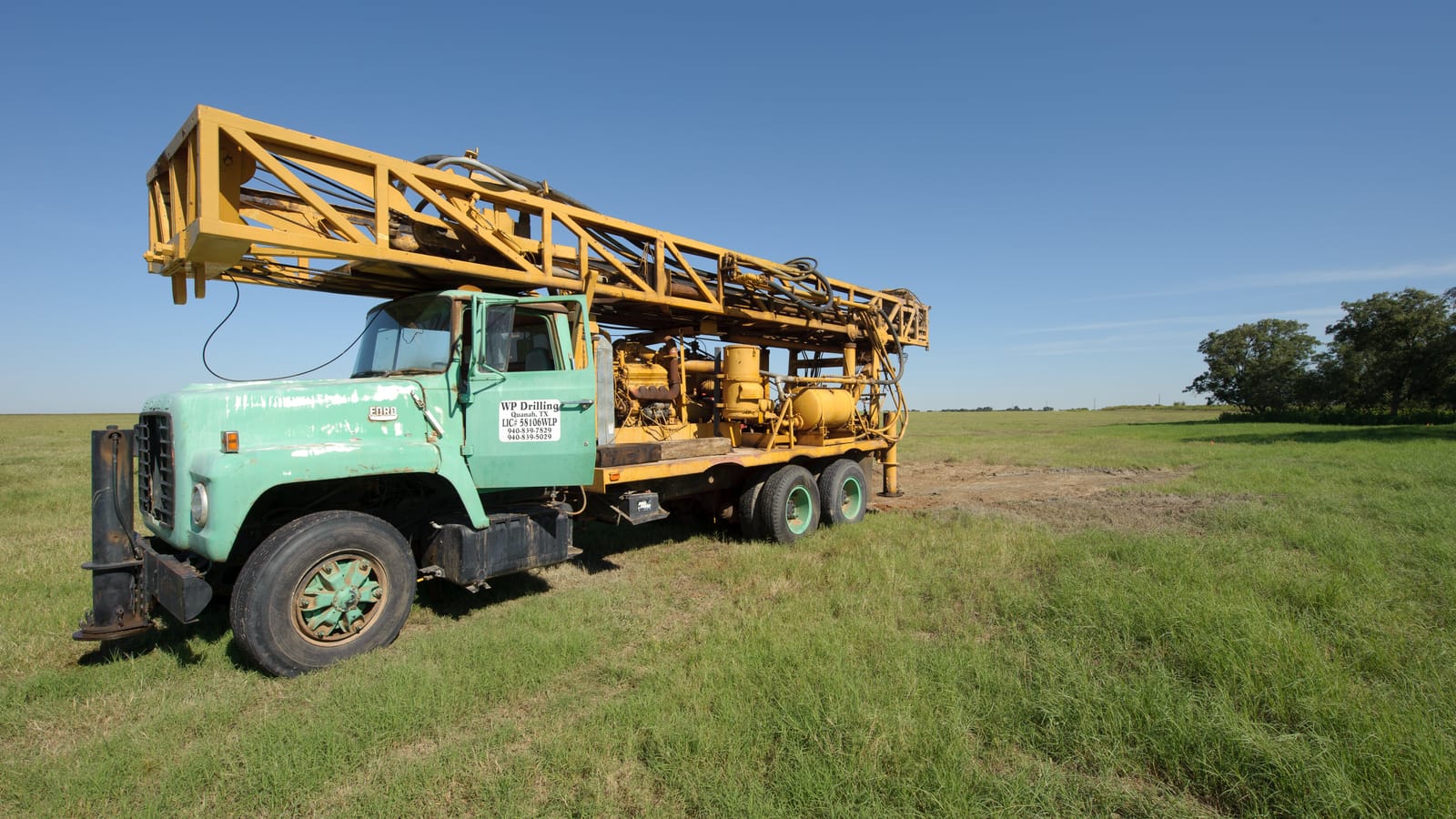
The well drilling rig is a complete system that drills wells or holes in the subsurface, and it may be carried on a truck, on tracks or on a trailer. A water well rig drives a string of drill pipes with a cutting head fitted at the lower end, and air, water or mud is used to bring out the cuttings and cool the head. Rotary drilling is the most common method in deep rock. The life of a drilling system is measured in the operating hours of the engine, the compressor and the pumps, and kilometres are added for the chassis of the carrier truck. In the Kingdom part of the drinking water comes from non-renewable groundwater in the deep strata, and this is what keeps artesian drilling an active business. The word “hafar” alone is also used in the market for the Bokalin, so “abar” (wells) must be mentioned to distinguish this machine.
Uses
- Drilling groundwater wells for farms, establishments and sites far from the network.
- Installing monitoring wells to measure groundwater levels and take samples.
- Drilling blast holes in quarries and mines.
- Drilling pile holes and foundation work.
- Geological exploration and taking soil and rock samples.
- Deepening an existing well when its water level drops.
02Classes and sizes
Drilling rigs are classified by the drilling method and by the carrier, and are not reduced to a single figure, since the depth and diameter available for each model are in the manufacturer’s bulletin. The references state that most drilling machines for shallow wells are mounted on large trucks, trailers or tracks.
| Class | Description | Typical use |
|---|---|---|
| Air rotary | A rotating head that pushes air to bring out the cuttings | Hard rock formations. |
| Mud rotary | A drilling fluid that is continuously controlled to support the hole walls | Soft and loose formations. |
| Down-the-hole hammer | A hammer fixed directly above the cutting head | Hard rock, and the air hammer for relatively shallow drilling. |
| Cable tool | A head that is raised and dropped, the oldest type | Rare today and much slower than rotary. |
| Small and auger | Light rigs moved by hand | Shallow wells and samples. |
03Main components
- 01The mast and its raising and lowering cylinders.
- 02The top rotary head or the rotary table.
- 03The string of drill pipes connected with threaded joints and the cutting head.
- 04The power source: the truck engine or an auxiliary engine on the frame.
- 05The air compressor in the air rigs.
- 06The mud pump and the mud pit in the mud rigs.
- 07The hoist winch and its ropes for fitting the pipes and casing.
- 08The hydraulic legs to fix and level the rig.
- 09The hydraulic system and the control panel.
- 10The casing pipes and the sealing fill around the well.
04Periodic maintenance schedule
The usual ladder for a drilling system, and the manual for the specific model sets the intervals and tasks that apply; the intervals are shorter in heavy dust and sand.
| Interval | Typical tasks |
|---|---|
| Every 10 hours / daily |
|
| Every 50 hours / weekly |
|
| Every 250 hours |
|
| Every 500 hours |
|
| Every 1000 hours |
|
| Every 2000 hours |
|
The carrier chassis follows the kilometre schedule of a heavy truck.
The manufacturer’s manual governs. The actual intervals and tasks are set by the operation and maintenance manual for your machine’s model, and they are shortened in heavy dust, high heat and continuous operation. This table shows the general order only and does not replace the manual.
05Daily pre-start checklist
14 items
06Common operating mistakes that cause breakdowns
- Setting up the rig on soft or sloping ground without fixing and levelling the legs.
- Overloading the cutting head or rotating it too fast, so the teeth and pipes are damaged.
- Leaving the string stationary in the hole with no rotation and no air or fluid pushed, so it sticks.
- Running the air hammer without lubricating the air as the manual specifies.
- Neglecting to clean and grease the threaded joints before every addition.
- Running the compressor or the mud pump with a low oil level or blocked filters.
- Leaving the mast raised during movement or transport.
- Neglecting to seal the space between the casing pipe and the hole, so surface contaminants reach the water-bearing layer.
07Regulatory requirements
Regulatory procedures to check when owning or operating this machine in the Kingdom.
08What to weigh when renting or buying
- The drilling method suited to the formation: rock, sand or clay, since it determines the type of rig.
- The depth and diameter required and their match to the model’s specification.
- The engine, compressor and mud pump hours with the maintenance record.
- The condition of the mast, its welds, its cylinders and the winch ropes.
- The quantity of pipes, accessories and cutting heads supplied and their condition.
- The condition of the truck chassis, its brakes and its tyres, and its meter if it is truck-mounted.
- When renting: whether the contract includes the crew, the fuel, the pipes, the cutting heads and failures caused by rock.
- Clarity on who bears a well whose drilling got stuck or gave no water.
Settle these factors first, then enter your own numbers in the Own vs rent calculator or the Equipment operating cost per hour calculator.
09Frequently asked questions
The well drilling rig is a system that drills wells with rotating pipes or by percussion. The Bokalin is an arm-and-bucket excavator that digs shallow trenches and foundations, and the two machines are not alike even though the word “hafar” is said for both.
Air rotary, mud rotary, down-the-hole hammer and the cable tool rig, and the ground formation decides the most suitable type.
In the first, air brings out the cuttings and cools the head, and in the second, the drilling fluid is controlled to support the hole walls in soft formations.
Yes, there are small auger rigs moved by hand, and hand drilling methods for shallow wells, but they do not reach the depths that rotary rigs on trucks reach.
The depth, the diameter, the nature of the formation, the casing pipes, the access to the site and the duration of execution, and the contractor sets it in a written quote after inspecting the site, and no general figure can be stated for it.
The drilling type suited to the formation, what the contract includes of crew, fuel and pipes, and who bears the failures caused by rock, as in the section above.
The engine, compressor and mud pump hours, the mast and its welds, the pipes and cutting heads, the maintenance record, and the condition of the carrier chassis.
By fixing the casing pipe and sealing the space around it with bentonite clay or concrete, and with a tight cap on the wellhead.