- Names used in Saudi Arabia
- Pickup truckPickupUteLight truck pickupBakab (Saudi term)WanitHilux
- Formal name
- شاحنة خفيفة مكشوفة
- English name
- Pickup truck
- Family
- Vehicles · Light vehicles
- Measured by
- Kilometres
01Definition and uses
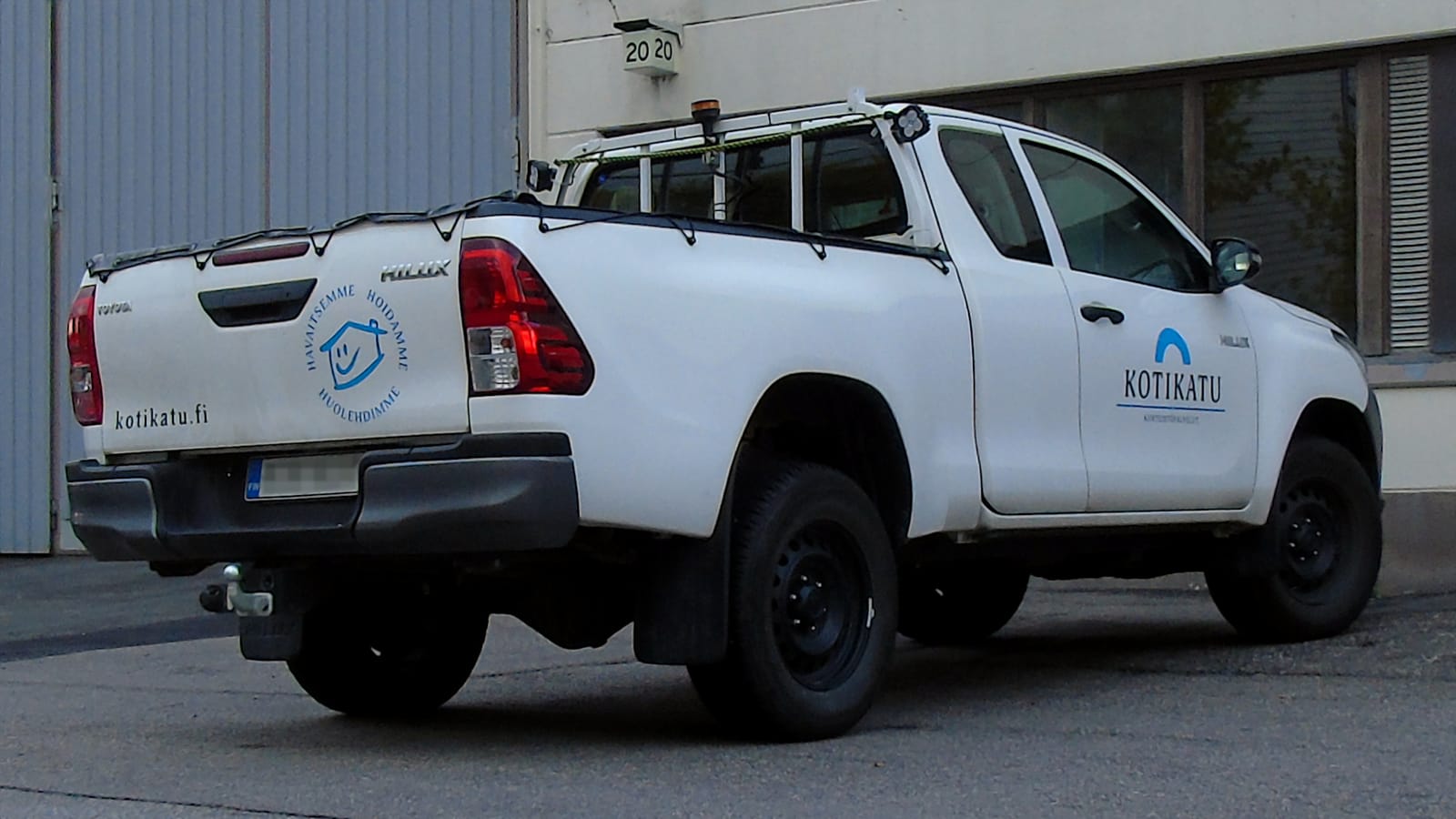
The pickup is a light or medium truck with an enclosed cab and an open rear cargo bed with three short walls and no roof. In the Saudi market it is called “bakab” or “wanit”, and “Hilux” is also said after its best-known model, a series of pickup trucks that Toyota has produced since 1968, some of whose generations were issued with specifications special to the Gulf countries. Pickup trucks and vans are classified among light commercial vehicles in the European Union classification. It is a road vehicle measured in kilometres, and it is used as a work tool and a travel vehicle at the same time. The name includes the diesel pickup that is common in institutions and contracting. The pickup is not the Dyna, since the Dyna is a truck with a cab over the engine and a heavier chassis.
Uses
- Carrying tools, light materials and workers to sites.
- Field supervision of projects and unpaved roads with four-wheel drive.
- Carrying a toolbox, a fuel tank or a small water tank on the bed.
- Towing light trailers, boats and small equipment.
- Mobile maintenance services and electricity and telecom crews.
- Emergency, security and municipal work.
- Light agricultural work and carrying produce and fodder.
- Leasing to individuals and companies for short projects.
02Classes and sizes
Light trucks are classified by gross weight, and the limits differ between countries: the upper gross weight limit in the European classification is lower than in the American one. What is relied on in practice for the pickup is the load and weight stated in the vehicle’s registration card and the manufacturer’s bulletin.
| Class | Description | Typical use |
|---|---|---|
| Single cab | One row of seats and two doors | Field work with a large load and a small team. |
| Extended cab | Extra space behind the two seats | Carrying tools inside the cab. |
| Double cab | Four doors and seats for five or six | Work and supervision teams. |
| Rear-wheel drive | The engine drives the two rear wheels | Paved roads and transport work. |
| Four-wheel drive | The engine drives all four wheels | Unpaved sites and sand. |
| Heavy-duty | A model with a higher load and towing capacity | Hard work and towing trailers. |
03Main components
- 01The diesel or petrol engine and the cooling and lubrication system.
- 02The manual or automatic gearbox and, on four-wheel drive, the transfer case.
- 03The two axles and the two propeller shafts.
- 04The brakes, with their discs, wheel cylinders and fluid.
- 05The suspension: leaf or coil springs and shock absorbers.
- 06The steel chassis, the cargo bed and the rear tailgate.
- 07The tyres and rims.
- 08The air conditioning and the cabin filter.
- 09The battery, the electrical system and the lighting.
- 10The seat belts and the airbags.
04Periodic maintenance schedule
Pickup maintenance is built on kilometres with a time limit, and the intervals shorten in extreme heat, sand, repeated loading, towing and site work. The following ladder is the usual one, and the model manual in the manufacturer’s handbook sets the intervals and tasks that apply.
| Interval | Typical tasks |
|---|---|
| Daily before moving |
|
| Weekly |
|
| Every 5,000 to 10,000 km |
|
| Every 20,000 km |
|
| Every 40,000 km |
|
| Every 80,000 km or annually |
|
The manufacturer’s manual governs. The actual intervals and tasks are set by the operation and maintenance manual for your machine’s model, and they are shortened in heavy dust, high heat and continuous operation. This table shows the general order only and does not replace the manual.
05Daily pre-start checklist
14 items
The general reference for commercial transport vehicles requires the driver to check the brakes, the parking brake, the steering, the lighting, the tyres, the horn, the wipers, the mirrors and the emergency equipment, and it serves as a standard for the pickup driver.
06Common operating mistakes that cause breakdowns
- Loading the bed above the declared load, which ruins the springs and shock absorbers and stresses the chassis.
- Driving on under-inflated tyres or on tyres of different sizes.
- Loading at the rear of the bed or on one side with no balance.
- Driving in sand with unsuitable tyre pressure or digging in with four-wheel drive without deflating.
- Delaying the oil and air filter change in dust.
- Neglecting to wash the underbody after muddy ground, so the chassis corrodes.
- Towing above the declared towing capacity or without brakes on the trailer where needed.
- Using the vehicle outside its registered purpose or by a driver who is not authorised.
07Regulatory requirements
Regulatory procedures to check when owning or operating this machine in the Kingdom.
08What to weigh when renting or buying
- The cab suited to the size of the team: single or double.
- Four-wheel or rear-wheel drive according to the work roads.
- The condition of the chassis for rust, twisting and towing marks, which show in hard use.
- The actual odometer reading with the maintenance record at a known dealer or workshop.
- The condition of the bed: the floor, sides and fixing points.
- The condition of the suspension and the rear springs and signs of overloading.
- The condition of the body and paint, since the traces of previous accidents show in the gaps and the paint mismatch.
- The registration card, the insurance and the soundness of ownership when buying used from the open market or the “haraj” (classified market).
- When renting: who bears the maintenance, the insurance, the tyres and the violations, and the daily distance ceiling.
Settle these factors first, then enter your own numbers in the Own vs rent calculator or the Equipment operating cost per hour calculator.
09Frequently asked questions
The bakab is a light truck with an enclosed cab and an open cargo bed. “Bakab” and “wanit” are two names for the same vehicle in the market, and “Hilux” is a model name that became so famous that it is said of the whole class.
Single, extended and double cab, rear-wheel or four-wheel drive, and a heavy-duty model.
Diesel is more common in institutions and contracting for its torque under load and towing, and it requires care of the fuel filter and the water separator; the choice is made on your own operating data, not on a general rule.
The maintenance record, the odometer, the condition of the chassis, the bed, the suspension, the engine, the gearbox, the registration card and the insurance, as in the section above.
The cab and the drive, who bears the maintenance, the insurance and the violations, the daily distance limit, and the condition of the tyres at handover.
The pickup is a light vehicle with a front cab and a lighter chassis, and the Dyna is a truck with a cab over the engine capable of a greater load and fitted bodies such as the tipper and the crane.
It is the name borrowed from English for the same “bakab”, and some countries call it by another local name.